-
Stay Away from Hewlett-Packard
Posted by Eddy Elfenbein on February 23rd, 2012 at 1:03 pmLast year, when Hewlett-Packard ($HPQ), was trading at $43, I warned investors to get out. Today, it’s at $27.
This is unfortunate because HPQ could be a very good company; but right now, it’s a big mess. I don’t think they even know what business they’re in. After yesterday’s close, Hewlett came out with a horrible earnings report. Earnings dropped 32% (but actually beat expectations), and the company guided lower for this quarter.
The shares have been down as much as 7.2% today, although they’ve come back some. This must be very frustrating for shareholders because until today, the stock had been doing fairly well coming off its October low. And that was very lowly low.
For now, Hewlett-Packard is sticking with is full-year guidance of $4 per share, so you might be thinking, “Hey, $4 ain’t too shabby from a $28 stock.” Not so fast. This is a classic value trap. HPQ isn’t down because it’s cheap. It’s down because it’s lost. Hewlett-Packard is a long, long way from being healthy. Meg Whitman herself said that it will take years before HPQ is competitive again.
I repeat, Hewlett-Packard is a sell.
-
Companies Are Guiding Lower
Posted by Eddy Elfenbein on February 23rd, 2012 at 9:00 amThe Wall Street Journal reports today that corporations are cutting guidance at the fastest rate since 2009. That’s one of the those headlines that strikes you as sounding terrible, but as you give it more thought, it’s not nearly as dire as it sounds. Of course, once every three years there’s going to be the worst something in the last three years.
Also, we’re talking the second derivative here. Companies are still earning money, and profits are still growing. The difference is that the rate of growth is slowing.
Fifty-eight companies have released estimates for first-quarter earnings that fall below analyst consensus, compared with 23 that beat Wall Street. That’s the largest ratio of negative to positive announcements since the first quarter of 2009, when the S&P 500 was on its way to bottoming out below 700 in early March.
“We’re seeing more negative guidance than usual,” said Greg Harrison, earnings analyst with Thomson Reuters. Estimated profits for 2012 have steadily fallen since October. The average S&P 500 company currently expects to add 8.3% in profits for the year. Just over a month ago, that estimate was at 10%.
This is an extension of what I mentioned in last week’s CWS Market Review: profit margins have gone as far as they can go. You can cut expenses to boost profits, but that game isn’t a long-term plan.
At some point, you need to bring in more revenue. Since companies can’t do much about raising prices in this environment, they need to sell more widgets. That means more customers, and that means more jobs.
Today’s jobless claims (351,000, a four-year low) was more good news for workers — and equities.
-
Target’s Earnings Were Good — And Possibly Bad
Posted by Eddy Elfenbein on February 23rd, 2012 at 8:54 amFrom this morning:
The AP:
Target’s 4Q profit declines 5.2 percent
Reuters:
-
Morning News: February 23, 2012
Posted by Eddy Elfenbein on February 23rd, 2012 at 5:26 amFitch Downgrades Greece on Debt Swap Plan
German Business Confidence Hit 7-Month High in February
Commerzbank Plans Capital Boost With Swap
Royal Bank of Scotland Posts Loss Twice as Big as Expected
Italian Consumer Confidence Rose More Than Forecast in February
Buffett’s Berkshire Muscles into Thai Reinsurance
S&P 500 Gets 9% Cheaper as Record Profit Restores $3.2 Trillion to Stocks
Winners and Losers From a Tax Proposal
Responding to Critics, S.E.C. Defends ‘No Wrongdoing’ Settlements
The Volcker Rule, Made Bloated and Weak
GM-Peugeot Still Seen as European Money-Losers
H-P Profit Tumbles 44%; No Quick Fix, Says CEO
Greek Bailout Leaves Europe on Road to Disaster: Clive Crook
Jeff Miller: Big Market Worries: Profit Margins
Global Macro Monitor: The Current Housing Bust is Much Worse Than The Great Depression
Be sure to follow me on Twitter.
-
GDP-Linked Bonds Are Complete BS
Posted by Eddy Elfenbein on February 22nd, 2012 at 7:58 pmProfessor Robert Shiller is again arguing for GDP-linked bonds. These bonds would be based on 1/1,000,000,000,000th of a country’s Gross Domestic Product. The shorter name is “Trill” for one-trillionth.
Shiller argues that we can solve the debt crisis by replacing treasury bills with Trills. The first mistake is that a debt problem is caused by…well, too much debt. A Trill is simply a different debt instrument. Changing the instrument of debt doesn’t change the existence of debt.
The other problem with Trills is that they don’t make any sense for the issuer. When Shiller first wrote about this two years ago, David Merkel noted that the rational price for a Trill is infinite, and Felix Salmon repeats this again today. Lots of people are confused on this point, but David and Felix are exactly right.
Of course, no one is going to pay an infinite price. Instead, when a rational price is infinite, it means that it’s not rational to issue a Trill to begin with.
Think of it this way: You’re in business and you want a loan. Let’s say that the loan is at 5%. This means that both you and the lender believe that you can get a return-on-equity of at least 5% with that money. If you don’t think you can, there’s no need for you to borrow it, and there’s no incentive for the loaner to lend it. With a Trill, it’s impossible for the borrower to ever exceed the interest payments. It’s a never-ending cycle. It would be as if you, the business person, had instead earned a 12% return-on-equity on the lender’s money. So now you owe 12% to the lender. What’s the point?
Here’s a comment I had left at David’s site on one of his Trill posts:
A few quick points.
There’s no way to pay off a Trill except by running a budget surplus or by issuing conventional debt, thus negating the need for Trills.
There might also be a slight risk premium due to the uncertainty of each coupon payment. It might be small but even a small amount comes of out taxpayers’ wallets.
The Q3 GDP for 1983 has been revised 10 times since it first came out. The last time was in 2009. Imagine the headache for Trills.
I keep coming back to your point that Trills would be worth an infinite amount. I think that’s exactly right. For the borrower, Trills are irrational. The US Treasury can get the exact same thing for less.
-
State Favorability Ratings
Posted by Eddy Elfenbein on February 22nd, 2012 at 12:35 pmBelow are the results of Public Policy Polling’s poll of states’ favorability ratings. They asked voters across the country what their impressions were of each state.
I thought the results were fascinating. A few months ago I asked readers, “If we had to, which state should we boot from the union?” The results were somewhat similar.
State +/- Margin Hawaii 54-10 44 Colorado 44-9 35 Tennessee 48-14 34 South Dakota 42-8 34 Virginia 45-13 32 Montana 39-7 32 Alaska 46-17 29 Oregon 43-14 29 North Carolina 40-11 29 Pennsylvania 40-11 29 Washington 43-17 26 Kentucky 42-16 26 Iowa 42-17 25 Oklahoma 40-16 24 Vermont 39-15 24 Wisconsin 40-17 23 Wyoming 34-11 23 Florida 43-21 22 North Dakota 33-11 22 Missouri 32-11 21 New Hampshire 37-18 19 Indiana 31-12 19 Idaho 30-11 19 Nebraska 29-11 18 Arizona 39-22 17 Michigan 38-21 17 Maine 32-15 17 Ohio 34-18 16 Delaware 32-16 16 Maryland 31-15 16 South Carolina 34-19 15 New Mexico 30-15 15 Kansas 28-13 15 New York 40-29 11 Georgia 31-20 11 Minnesota 27-17 10 Rhode Island 26-16 10 Texas 40-31 9 Massachusetts 35-27 8 West Virginia 23-15 8 Arkansas 25-20 5 Connecticut 26-22 4 Nevada 28-26 2 Alabama 27-26 1 Louisiana 24-24 0 Utah 24-27 -3 Mississippi 22-28 -6 New Jersey 25-32 -7 Illinois 19-29 -10 California 27-44 -17 I think it’s interesting that New York and Texas are two of the most liked and disliked states.
Britain’s New 50% Top Tax Is Failing to Boost Revenue
Posted by Eddy Elfenbein on February 22nd, 2012 at 12:08 pmThe UK Telegraph reports:
The Treasury received £10.35 billion in income tax payments from those paying by self-assessment last month, a drop of £509 million compared with January 2011. Most other taxes produced higher revenues over the same period.
Senior sources said that the first official figures indicated that there had been “manoeuvring” by well-off Britons to avoid the new higher rate. The figures will add to pressure on the Coalition to drop the levy amid fears it is forcing entrepreneurs to relocate abroad.
The self-assessment returns from January, when most income tax is paid by the better-off, have been eagerly awaited by the Treasury and government ministers as they provide the first evidence of the success, or failure, of the 50p rate. It is the first year following the introduction of the 50p rate which had been expected to boost tax revenues from self-assessment by more than £1billion.
I’m not a believer in the Laffer Curve, the idea that higher tax rates produce less revenue. I concede that it might occur at extremely high rates like 70%. However, I think it’s perfectly reasonable to see a short-term effect and I’d guess that’s probably what we’re seeing in Britain.
People respond to incentives. The rest is details.
Does the Stock Market Love Inflation?
Posted by Eddy Elfenbein on February 22nd, 2012 at 10:13 amIt appears so. Here’s a graph of the S&P 500 versus the 10-year inflation premium (the 10-year T-bond yield minus the 10-year TIPs yield). Since 2008, these two series have been waltzing partners.
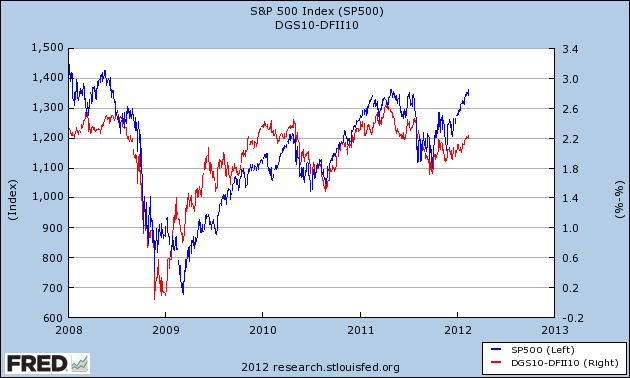
There’s no reason to expect a long-term relationship to last. After all, we’re comparing a price index to a yield. But, for whatever reason, whatever causes investors to expect more inflation seems to be highly aligned with higher equity prices. Correlation, of course, doesn’t mean causation.
Obama Wants 28% Corporate Tax Rate
Posted by Eddy Elfenbein on February 22nd, 2012 at 9:20 amPresident Barack Obama is proposing to cut the corporate tax rate from 35 percent to 28 percent and wants an even lower effective rate for manufacturers, a senior administration official says, as the White House lays down an election-year marker in the debate over tax policy.
In turn, corporations would have to give up dozens of loopholes and subsidies that they now enjoy. Corporations with overseas operations would also face a minimum tax on their foreign earnings.
Over the last 40 years, corporate taxes have fallen as a percentage of federal revenues. I can’t say if this has a realistic chance of becoming law. I would think that fighting for corporations during an election isn’t a good idea.
Of course, corporations don’t pay taxes. A corporation is just a piece of paper. The companies pass the cost on to their customers. The benefit for the government is that it hides their taxes by imbedding it in a third-party’s prices.
Walmart’s Trading Range Lives
Posted by Eddy Elfenbein on February 22nd, 2012 at 9:08 amA few weeks ago, I noted that Walmart ($WMT) has been trapped in the “Mother of All Trading Ranges” for the last 12 years. Not once in over 3,000 trading days has WMT closed above $64 or below $42. The last time it did was on January 19, 2000 when it closed at $64.06. More than 78% of the time, the stock been between $48 and $59.99.
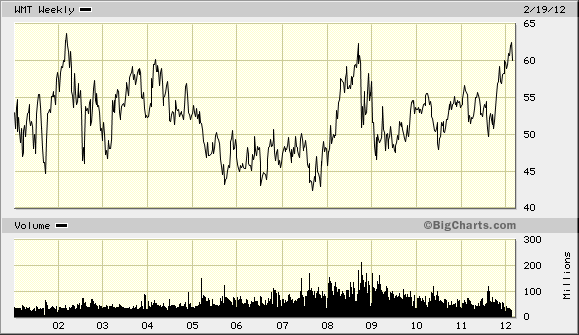
On Friday, the stock closed at $62.48 which is very close to the top of its range. It seemed like the strange range would finally be broken. But yesterday, Walmart’s disappointing earnings knocked the shares back to $60.07.
By the way, Walmart’s sales rose by 5.8% to $122.29 billion. That means that Walmart averaged $1 million in sales. A minute. Also, despite what people may think of how corporations are run, Walmart’s profit margin was just 4.24%.
-
Archives
- November 2026
- October 2026
- September 2026
- August 2026
- July 2026
- June 2026
- May 2026
- April 2026
- March 2026
- February 2026
- January 2026
- December 2025
- November 2025
- October 2025
- September 2025
- August 2025
- July 2025
- June 2025
- May 2025
- April 2025
- March 2025
- February 2025
- January 2025
- December 2024
- November 2024
- October 2024
- September 2024
- August 2024
- July 2024
- June 2024
- May 2024
- April 2024
- March 2024
- February 2024
- January 2024
- December 2023
- November 2023
- October 2023
- September 2023
- August 2023
- July 2023
- June 2023
- May 2023
- April 2023
- March 2023
- February 2023
- January 2023
- December 2022
- November 2022
- October 2022
- September 2022
- August 2022
- July 2022
- June 2022
- May 2022
- April 2022
- March 2022
- February 2022
- January 2022
- December 2021
- November 2021
- October 2021
- September 2021
- August 2021
- July 2021
- June 2021
- May 2021
- April 2021
- March 2021
- February 2021
- January 2021
- December 2020
- November 2020
- October 2020
- September 2020
- August 2020
- July 2020
- June 2020
- May 2020
- April 2020
- March 2020
- February 2020
- January 2020
- December 2019
- November 2019
- October 2019
- September 2019
- August 2019
- July 2019
- June 2019
- May 2019
- April 2019
- March 2019
- February 2019
- January 2019
- December 2018
- November 2018
- October 2018
- September 2018
- August 2018
- July 2018
- June 2018
- May 2018
- April 2018
- March 2018
- February 2018
- January 2018
- December 2017
- November 2017
- October 2017
- September 2017
- August 2017
- July 2017
- June 2017
- May 2017
- April 2017
- March 2017
- February 2017
- January 2017
- December 2016
- November 2016
- October 2016
- September 2016
- August 2016
- July 2016
- June 2016
- May 2016
- April 2016
- March 2016
- February 2016
- January 2016
- December 2015
- November 2015
- October 2015
- September 2015
- August 2015
- July 2015
- June 2015
- May 2015
- April 2015
- March 2015
- February 2015
- January 2015
- December 2014
- November 2014
- October 2014
- September 2014
- August 2014
- July 2014
- June 2014
- May 2014
- April 2014
- March 2014
- February 2014
- January 2014
- December 2013
- November 2013
- October 2013
- September 2013
- August 2013
- July 2013
- June 2013
- May 2013
- April 2013
- March 2013
- February 2013
- January 2013
- December 2012
- November 2012
- October 2012
- September 2012
- August 2012
- July 2012
- June 2012
- May 2012
- April 2012
- March 2012
- February 2012
- January 2012
- December 2011
- November 2011
- October 2011
- September 2011
- August 2011
- July 2011
- June 2011
- May 2011
- April 2011
- March 2011
- February 2011
- January 2011
- December 2010
- November 2010
- October 2010
- September 2010
- August 2010
- July 2010
- June 2010
- May 2010
- April 2010
- March 2010
- February 2010
- January 2010
- December 2009
- November 2009
- October 2009
- September 2009
- August 2009
- July 2009
- June 2009
- May 2009
- April 2009
- March 2009
- February 2009
- January 2009
- December 2008
- November 2008
- October 2008
- September 2008
- August 2008
- July 2008
- June 2008
- May 2008
- April 2008
- March 2008
- February 2008
- January 2008
- December 2007
- November 2007
- October 2007
- September 2007
- August 2007
- July 2007
- June 2007
- May 2007
- April 2007
- March 2007
- February 2007
- January 2007
- December 2006
- November 2006
- October 2006
- September 2006
- August 2006
- July 2006
- June 2006
- May 2006
- April 2006
- March 2006
- February 2006
- January 2006
- December 2005
- November 2005
- October 2005
- September 2005
- August 2005
- July 2005
 Eddy Elfenbein is a Washington, DC-based speaker, portfolio manager and editor of the blog Crossing Wall Street. His