-
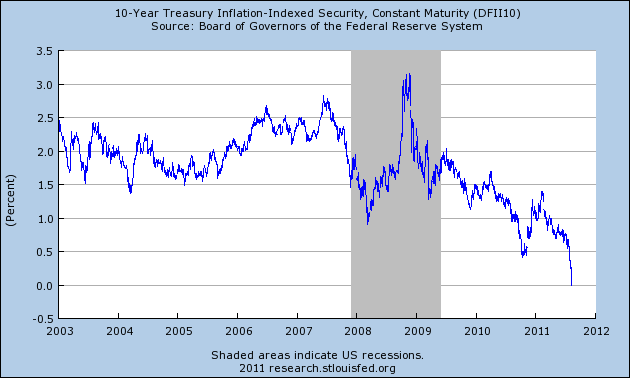
10-Year TIPs Yield = 0%
Posted by Eddy Elfenbein on August 11th, 2011 at 2:16 pmAmazing.
-
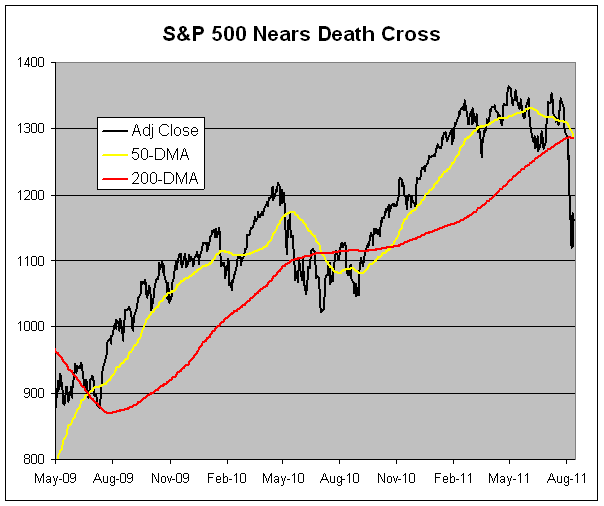
S&P 500 Nears Death Cross
Posted by Eddy Elfenbein on August 11th, 2011 at 1:27 pmThe S&P 500 is very close to reaching a “Death Cross.” This is when the 50- and 200-DMA cross.
This time, the 50-DMA is set to fall below the 200-DMA which technicians consider a signal of more bearishness ahead.
Last summer, the 50-DMA was below the 200-DMA from July 1 to October 21. Bear in mind that the S&P 500 rose 15% over that time so this is hardly a perfect indicator.
The key number for today is 1158.84. If the S&P closes above that, the 50-DMA will still be above the 200-DMA.
-
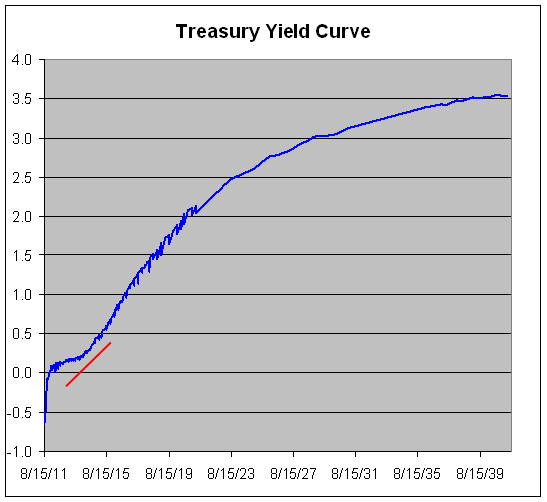
The Notch In the Yield Curve
Posted by Eddy Elfenbein on August 11th, 2011 at 11:22 amThis is an important point but it’s difficult for me to explain so please bear with me. Below is the current Treasury yield curve. The key part is the notch that extends out about three years (I added the red line to highlight the area). The blue line is pretty flattish and doesn’t start to rise until 2014 or 2015.
Embedded in any yield curve is a prediction of where short-term interest rates will be in the future. The steepness of the blue line indicates how quickly rates will rise.
What’s happened recently is that the market doesn’t expect rates to rise for some time. This is a direct response to the Fed’s throwing the towel announcement from earlier this week. In turn, this has led investors to crowd into gold.
Normally, a steep yield curve is very good for stocks (and banks). The problem is that steepness doesn’t really start on the yield curve until about three years out.
-
Will They Ever Learn?
Posted by Eddy Elfenbein on August 11th, 2011 at 10:37 amOnce again, regulators consider a bad idea that refuses to die:
Europe Considers Ban on Short Selling
BRUSSELS — A European market regulator is considering recommending a temporary ban on negative bets against stocks across the Continent in an effort to stop the tailspin in the markets.
The European Securities and Markets Authority, a body that coordinates the European Union’s market policies, has been requesting information from member states about such bets against stocks, known as short-sales.
In such deals, a trader sells borrowed shares in hopes that they will decline in value before he has to buy them back to close out his loan. The difference in price is his profit, or loss. Critics say short-selling encourages speculation and pushes stock prices down, sometimes feeding on itself in a panicked market, while advocates say it keeps the market honest and maintains liquidity.
“We are discussing with national authorities and together we will decide whether we need coordinated action,” Victoria Powell, a spokeswoman for the authority, said Thursday. She declined to comment on the timing of any decision or its possible scope.
Short-selling is crucial to an orderly market. It’s difficult to over-state how important this is. Shorting is what gives a trader his power. It’s an energy field created by all tradeable securities. It surrounds us, penetrates us, and binds the markets together.
Short-selling is most important right now because it helps the market uncover the weakest firms. I find it interesting that regulators continue to blame short-sellers. The fact is that regulators overwhelmingly failed in finding problem spots in the economy and that’s exactly what the shorts did.
-
Understatement of the Year
Posted by Eddy Elfenbein on August 11th, 2011 at 10:16 amLadies and gentlemen, I hope you’re sitting down:
In other news, Napoleon concedes that invading Russia “may have been a bad idea.”
-
Dividend Yields on S&P Financial Stocks
Posted by Eddy Elfenbein on August 11th, 2011 at 9:39 amFinancial stocks have been getting battered and bruised. The Financial Sector ETF ($XLF) was over $17 earlier this year. Now it’s at $12.
Here’s a look at how some the dividend yields stack up:
Stock Symbol Price Dividend Yield Ace Limited ACE $59.35 $1.43 2.41% AFLAC AFL $35.57 $1.20 3.37% AIG AIG $22.14 AIMCO AIV $23.32 $0.48 2.06% Assurant AIZ $31.23 $0.72 2.31% Allstate ALL $24.32 $0.84 3.45% Ameriprise Financial AMP $41.19 $0.92 2.23% Aon Corporation AON $43.36 $0.60 1.38% AvalonBay Communities AVB $125.67 $3.57 2.84% American Express AXP $42.80 $0.72 1.68% Bank of America BAC $6.77 $0.04 0.59% BB&T Corporation BBT $19.86 $0.64 3.22% Franklin Resources BEN $109.44 $1.00 0.91% Bank of New York Mellon BK $19.46 $0.52 2.67% Berkshire Hathaway BRKB $67.60 Boston Properties BXP $95.66 $2.00 2.09% Citigroup C $28.49 $0.04 0.14% Chubb Corporation CB $56.51 $1.56 2.76% CB Richard Ellis Group CBG $16.67 Cincinnati Financial CINF $24.03 $1.60 6.66% Comerica CMA $24.22 $0.40 1.65% CME Group CME $239.21 $5.60 2.34% Capital One Financial COF $41.05 $0.20 0.49% Discover Financial Services DFS $21.88 $0.24 1.10% Equifax EFX $29.54 $0.64 2.17% Equity Residential EQR $56.01 $1.35 2.41% E*TRADE Financial ETFC $10.66 First Horizon National FHN $6.76 $0.04 0.59% Federated Investors FII $16.91 $0.96 5.68% Fifth Third Bancorp FITB $9.42 $0.24 2.55% Genworth Financial GNW $5.78 Goldman Sachs GS $110.34 $1.40 1.27% Huntington Bancshares HBAN $4.71 $0.16 3.40% Hudson City Bancorp HCBK $6.10 $0.32 5.25% Health Care REIT HCN $43.40 $2.86 6.59% HCP HCP $31.44 $1.92 6.11% Hartford Financial Services HIG $18.15 $0.40 2.20% Host Hotels & Resorts HST $12.00 $0.12 1.00% IntercontinentalExchange ICE $109.80 Invesco Plc IVZ $16.62 $0.49 2.95% Janus Capital Group JNS $6.49 $0.20 3.08% JP Morgan Chase JPM $34.37 $1.00 2.91% KeyCorp KEY $6.20 $0.12 1.94% Kimco Realty KIM $15.87 $0.72 4.54% Loews Corporation L $34.54 $0.25 0.72% Legg Mason LM $24.63 $0.32 1.30% Lincoln National LNC $20.67 $0.20 0.97% Leucadia National LUK $26.43 $0.25 0.95% Moody’s MCO $29.15 $0.56 1.92% MetLife MET $31.83 $0.74 2.32% Marsh & McLennan MMC $26.83 $0.88 3.28% Morgan Stanley MS $16.45 $0.20 1.22% M&T Bank MTB $70.39 $2.80 3.98% The NASDAQ OMX Group NDAQ $21.47 Northern Trust NTRS $36.13 $1.12 3.10% NYSE Euronext NYX $26.87 $1.20 4.47% People’s United Financial PBCT $10.74 $0.63 5.87% Plum Creek Timber PCL $35.25 $1.68 4.77% Principal Financial Group PFG $22.16 $0.55 2.48% Progressive PGR $17.31 $0.40 2.31% ProLogis PLD $26.40 $1.12 4.24% PNC Financial Services PNC $45.28 $1.40 3.09% Prudential Financial PRU $47.77 $1.15 2.41% Public Storage PSA $109.62 $3.80 3.47% Regions Financial RF $4.23 $0.04 0.95% Charles Schwab SCHW $12.05 $0.24 1.99% SLM Corporation SLM $13.08 $0.40 3.06% Simon Property Group SPG $107.89 $3.20 2.97% SunTrust Banks STI $17.69 $0.04 0.23% State Street STT $33.24 $0.72 2.17% Torchmark TMK $33.56 $0.29 0.86% T. Rowe Price TROW $49.04 $1.24 2.53% The Travelers Companies TRV $49.04 $1.64 3.34% Unum Group UNM $21.31 $0.42 1.97% U.S. Bancorp USB $21.43 $0.50 2.33% Vornado Realty Trust VNO $77.51 $2.76 3.56% Ventas, Inc. VTR $44.99 $2.30 5.11% Wells Fargo WFC $22.88 $0.48 2.10% XL Group XL $18.78 $0.44 2.34% Zions Bancorporation ZION $16.06 $0.04 0.25% Morning News: August 11, 2011
Posted by Eddy Elfenbein on August 11th, 2011 at 7:41 amCentral Bankers Race to Protect Growth
French Banks Lead European Sector Lower
Italy’s Tremonti Seeks Budget Reform
Financial Turmoil Evokes Comparison to 2008 Crisis
In U.S. Stress Tests, a Tool to Gauge Contagion in Europe
Treasuries Fall Before Auction of 30-Year Bonds; U.S. Stock Futures Rise
U.S. Futures Rise Amid Volatile Trade
Gold Slips In Asia As Base Metals See Renewed Buying Interest
Insiders Buy Stocks at Highest Rate Since 2009
Apple’s Market Crown Is Tribute to Agility: The Ticker
Chinese E-Commerce Giant Alibaba Reports Q2 Net Up, Sees Global Econ Threat to H2
Internet Co AOL Authorizes $250 Million Stock Repurchase Program
Fitch: Capital One On Negative Watch On Bid For HSBC Card Unit
Anheuser-Busch InBev’s US Cost-Cutting, Brazil Price Hikes Boost Profit
Paul Kedrosky: How the West Was Lost and Where it Got Us
Stone Street: Trina Solar (Potential) Fraud Investigation Update: Definitely, Maybe…
Be sure to follow me on Twitter.
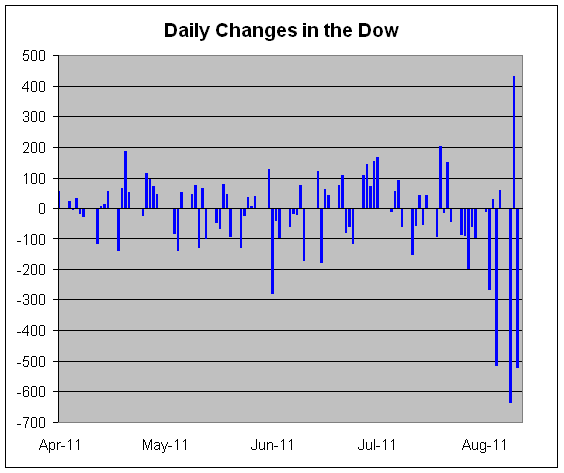
The Emergence of Volatility
Posted by Eddy Elfenbein on August 10th, 2011 at 10:55 pmToday was the Dow’s third 500+ loss in the last five days. Not too long ago, daily swings of more than 200 points were rare.
Check out how dramatically daily volatility has increased:
Out of Stocks and Into Bonds
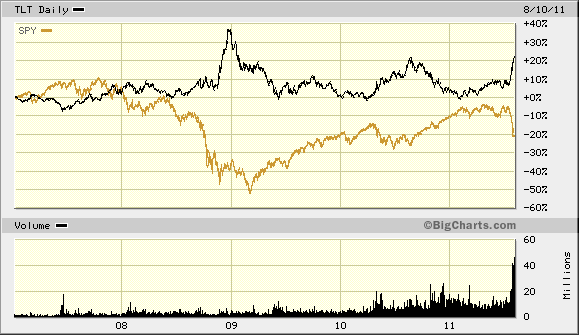
Posted by Eddy Elfenbein on August 10th, 2011 at 9:12 pmSometimes one chart says it all. This is the S&P 500 ETF ($SPY) compared with the Long-Term Treasury ETF ($TLT).
The two lines are nearly perfect mirror images. In the last three weeks, the lines have dramatically diverged. Going by this metric, the market isn’t nearly as unbalanced as it was two-and-a-half years ago.
Belloc 2011
Posted by Eddy Elfenbein on August 10th, 2011 at 8:49 pmWhatever happens, the rioters have got: The Maxim gun, and the police have not.
-
Archives
- October 2026
- September 2026
- August 2026
- July 2026
- June 2026
- May 2026
- April 2026
- March 2026
- February 2026
- January 2026
- December 2025
- November 2025
- October 2025
- September 2025
- August 2025
- July 2025
- June 2025
- May 2025
- April 2025
- March 2025
- February 2025
- January 2025
- December 2024
- November 2024
- October 2024
- September 2024
- August 2024
- July 2024
- June 2024
- May 2024
- April 2024
- March 2024
- February 2024
- January 2024
- December 2023
- November 2023
- October 2023
- September 2023
- August 2023
- July 2023
- June 2023
- May 2023
- April 2023
- March 2023
- February 2023
- January 2023
- December 2022
- November 2022
- October 2022
- September 2022
- August 2022
- July 2022
- June 2022
- May 2022
- April 2022
- March 2022
- February 2022
- January 2022
- December 2021
- November 2021
- October 2021
- September 2021
- August 2021
- July 2021
- June 2021
- May 2021
- April 2021
- March 2021
- February 2021
- January 2021
- December 2020
- November 2020
- October 2020
- September 2020
- August 2020
- July 2020
- June 2020
- May 2020
- April 2020
- March 2020
- February 2020
- January 2020
- December 2019
- November 2019
- October 2019
- September 2019
- August 2019
- July 2019
- June 2019
- May 2019
- April 2019
- March 2019
- February 2019
- January 2019
- December 2018
- November 2018
- October 2018
- September 2018
- August 2018
- July 2018
- June 2018
- May 2018
- April 2018
- March 2018
- February 2018
- January 2018
- December 2017
- November 2017
- October 2017
- September 2017
- August 2017
- July 2017
- June 2017
- May 2017
- April 2017
- March 2017
- February 2017
- January 2017
- December 2016
- November 2016
- October 2016
- September 2016
- August 2016
- July 2016
- June 2016
- May 2016
- April 2016
- March 2016
- February 2016
- January 2016
- December 2015
- November 2015
- October 2015
- September 2015
- August 2015
- July 2015
- June 2015
- May 2015
- April 2015
- March 2015
- February 2015
- January 2015
- December 2014
- November 2014
- October 2014
- September 2014
- August 2014
- July 2014
- June 2014
- May 2014
- April 2014
- March 2014
- February 2014
- January 2014
- December 2013
- November 2013
- October 2013
- September 2013
- August 2013
- July 2013
- June 2013
- May 2013
- April 2013
- March 2013
- February 2013
- January 2013
- December 2012
- November 2012
- October 2012
- September 2012
- August 2012
- July 2012
- June 2012
- May 2012
- April 2012
- March 2012
- February 2012
- January 2012
- December 2011
- November 2011
- October 2011
- September 2011
- August 2011
- July 2011
- June 2011
- May 2011
- April 2011
- March 2011
- February 2011
- January 2011
- December 2010
- November 2010
- October 2010
- September 2010
- August 2010
- July 2010
- June 2010
- May 2010
- April 2010
- March 2010
- February 2010
- January 2010
- December 2009
- November 2009
- October 2009
- September 2009
- August 2009
- July 2009
- June 2009
- May 2009
- April 2009
- March 2009
- February 2009
- January 2009
- December 2008
- November 2008
- October 2008
- September 2008
- August 2008
- July 2008
- June 2008
- May 2008
- April 2008
- March 2008
- February 2008
- January 2008
- December 2007
- November 2007
- October 2007
- September 2007
- August 2007
- July 2007
- June 2007
- May 2007
- April 2007
- March 2007
- February 2007
- January 2007
- December 2006
- November 2006
- October 2006
- September 2006
- August 2006
- July 2006
- June 2006
- May 2006
- April 2006
- March 2006
- February 2006
- January 2006
- December 2005
- November 2005
- October 2005
- September 2005
- August 2005
- July 2005
 Eddy Elfenbein is a Washington, DC-based speaker, portfolio manager and editor of the blog Crossing Wall Street. His