-
The Misweightings of the Dow
Posted by Eddy Elfenbein on August 10th, 2011 at 8:12 pmBelow is a listing of the 30 stocks in the Dow Jones Industrial Average ($DJIA). The Dow is a price-weighted index which means that it’s calculated by adding up all the prices of the 30 stocks and dividing by an index divisor. The divisor is currently 0.132129493.
Price-weighting is a really bad idea and it’s a holdover from the days before computers. The S&P 500 is based on each stock’s market value which is a far more accurate measure.
Because of the Dow’s price-weighting, you get some screwy results, and that’s only gotten worse lately. For example, the entirety of Bank of America ($BAC) is now worth just 51 Dow points. The stock’s depressed share price means that it has the smallest weighting in the index. In fact, it’s twice as smallest as the second-smallest.
I’ve listed each stock in the index along with today’s closing price, the stock’s weighting in the Dow, the market cap, the weighting if the Dow were market cap-weighted and lastly, the discrepancy. In other words, Alcoa has 2.15 times the weighting in the Dow that it should have. We can see that Travelers ($TRV) has three times the weighting in the Dow as General Electric ($GE) even though GE’s market cap is more than seven times TRV’s.
Stock Price Weighting Mkt Cap Weighting Difference Alcoa $11.60 0.82% $12.34 0.38% 2.15 American Express $42.80 3.02% $51.09 1.58% 1.92 Boeing $57.41 4.05% $42.55 1.31% 3.09 Bank Of America $6.77 0.48% $68.61 2.12% 0.23 Caterpillar $83.51 5.90% $53.95 1.67% 3.54 Cisco $13.73 0.97% $75.52 2.33% 0.42 Chevron $90.57 6.39% $181.41 5.60% 1.14 DuPont $44.83 3.17% $41.74 1.29% 2.46 Disney $31.54 2.23% $59.62 1.84% 1.21 General Electric $15.09 1.07% $159.96 4.94% 0.22 Home Depot $28.51 2.01% $45.39 1.40% 1.44 Hewlett-Packard $29.86 2.11% $61.93 1.91% 1.10 IBM $162.54 11.48% $194.12 5.99% 1.92 Intel $19.93 1.41% $105.51 3.26% 0.43 Johnson & Johnson $60.20 4.25% $165.02 5.09% 0.83 JPMorgan Chase $34.37 2.43% $136.05 4.20% 0.58 Kraft Foods $32.80 2.32% $57.93 1.79% 1.29 Coke $63.96 4.52% $146.86 4.53% 1.00 McDonald’s $84.08 5.94% $86.75 2.68% 2.22 3M $78.23 5.52% $55.51 1.71% 3.22 Merck $29.81 2.10% $92.01 2.84% 0.74 Microsoft $24.20 1.71% $202.75 6.26% 0.27 Pfizer $17.05 1.20% $134.71 4.16% 0.29 Procter & Gamble $58.51 4.13% $166.89 5.15% 0.80 AT&T $27.88 1.97% $165.22 5.10% 0.39 Travelers $49.04 3.46% $20.53 0.63% 5.46 United Technologies $67.44 4.76% $61.28 1.89% 2.52 Verizon $33.66 2.38% $95.28 2.94% 0.81 Walmart $48.41 3.42% $168.11 5.19% 0.66 Exxon Mobil $68.03 4.80% $330.77 10.21% 0.47 Disney Plunges on Earnings
Posted by Eddy Elfenbein on August 10th, 2011 at 11:14 amShares of Disney ($DIS) are getting crushed today on a questionable earnings report.
Shares of Walt Disney Co fell more than 14 percent in early trading Wednesday, a day after the company’s quarterly results failed to reassure investors that Disney could do well in a weak U.S. economy.
Barclays Capital, Wunderlich Securities, RBC and Evercore Partners all cut their price targets for Disney and lowered their expectations for its theme parks and TV networks.
Disney shares were down much more than its peer media companies despite posting solid results, dropping some $10 billion in market value.
Fiscal third-quarter profit was boosted by management’s decision to move some deferred revenue related to ESPN to the third quarter from the fourth quarter.
Excluding deferred revenue, results missed most analysts’ expectations
Disney executives told analysts the company is not seeing any advertiser downturn at its TV networks which include ABC and cable networks like ESPN and Disney branded channels. They also said hotel bookings were down by 2 percent less than it had previously forecast.
The odd thing is that the earnings report initially looked quite good. But once analysts dug through the numbers, they didn’t like what they saw. DIS got as low as $30.20 which is a 13% drop from yesterday’s close. The stock is lower than where it was in November 1997.
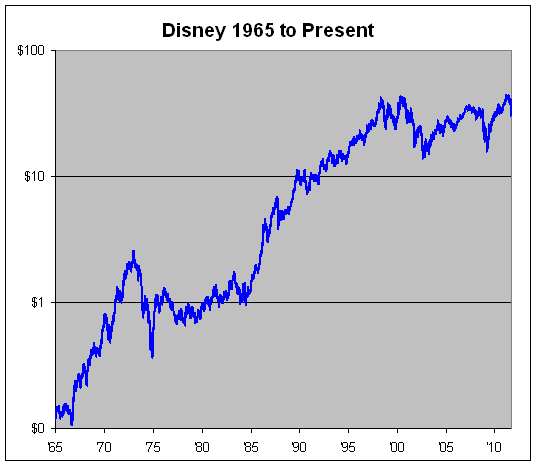
Disney was a super-star stock in the 1960s and early 70s. It was one the most prominent of the Nifty 50 fad in the early 70s. Much like the rest of those stocks, Disney plunged hard in the 1973-74 bear market.
The stock really didn’t get moving again until Michael Eisner took over in 1984. The stock soared by more than 42-fold from 1984 to 1998. Since then, the stock hasn’t done well at all.
The Fed Throws in the Towel and Stocks Soar
Posted by Eddy Elfenbein on August 10th, 2011 at 8:30 amThe Dow soared 429.92 points on Tuesday which came after Monday’s 634.76-point bloodbath. The S&P 500 jumped 4.74% yesterday which brings the loss for the week to 2.24%
Yesterday was an unusually frantic day of trading. At the time of the Fed’s announcement, the market was modestly higher. Once the FOMC news was digested, the market tanked hard.
By 2:45 pm, the S&P 500 hit 1,101.54 which was the lowest point in nearly a year. The market then suddenly put on a furious rally. From the intra-day low to the close, the market added 6.44%. Yowza. That ain’t bad for 75 minutes’ work.
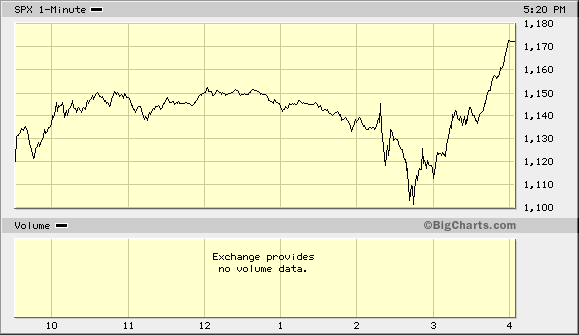
I’m not saying that the panic has passed, but I will note that the $VIX took a big tumble on Tuesday. That’s to be expected with a rally. The $VIX dropped 12.94 yesterday to close at 35.06. Once again, most of the decline came towards the end of the trading day.
I mentioned earlier that Tuesday was a classic “snapback” rally. In other words, what did the worst on Monday did the best on Tuesday. What did the best on Monday did the worst yesterday. As a result, the Morgan Stanley Cyclical Index (^CYC) finally outpaced the market. Before today, the CYC trailed the S&P for 17 out of the last 18 days.
Once again, the big action was in the bond market. Stocks go down and bonds go up. Then stocks go up and bonds…still go up.
The yield on the 10-year Treasury reached an absurd all-time low of 2.0346%. Yes, that’s an all-time low. On July 1st, the 10-year yielded 3.2%. The yield on the two-year Treasury dropped as low as 0.157% yesterday. The yield on the 10-year TIPs dropped into the minus camp for the first time ever.
Here’s a look at the dramatic change in the yield curve between July 25th and yesterday:
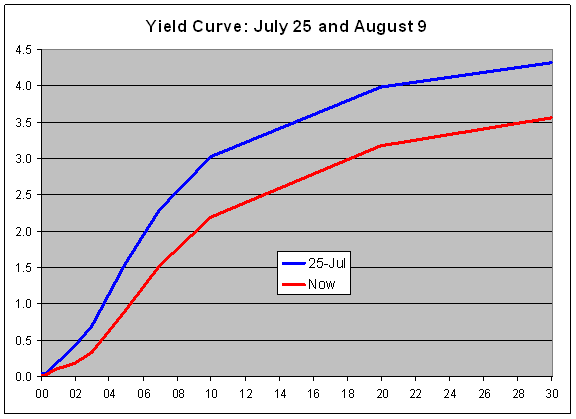
There’s now very little difference between the two-year and three-year Treasury yield. That’s a direct result of the Fed’s announcement. The market doesn’t expect the Fed to raise interest rates for at least a few more years.
Here’s a stat for you that shows you how much times have changed. Two years ago, a two-year Treasury yielded 1.32% and a three-year yielded 1.87%. That implied that the one-year yield would be at 2.97% in two years, meaning today.
Instead of yielding 2.97%, the one-year currently yields 0.11%.
Morning News: August 10, 2011
Posted by Eddy Elfenbein on August 10th, 2011 at 7:30 amChina’s Interest-Rate Swaps Snap Six-Day Decline on Fed Pledge
China Trade Surplus Widens In July, But Outlook Cloudy
Swiss National Bank’s Action Fails to Cool Franc
Central Bank Props Up Spain and Italy, for Now
European Stocks Advance as Fed Pledges Low Interest Rates; Nestle Gains
Bank of England’s King: Dangerous To Commit To Rate Moves
Commerzbank Profit Drops 93% on Greek Debt
Gold Steadies Near Lifetime High, Econ Worries Linger
Its Forecast Dim, Fed Vows to Keep Rates Near Zero
Goldman Says QE3 Likely After Dovish Fed Statement
Cost of Insuring U.S. Debt Against Default Falls
Technology Investors Turn Wary on Ventures
Europe’s HSBC to Reap $2.4 Billion Gain From Sale of U.S. Card Division
PepsiCo Joins Watchmaker Fossil Bracing for Weak Demand
Phil Pearlman: Far From The Maddening Crowd
Jeff Miller: The Fed Decision and the Market Reaction
Be sure to follow me on Twitter.
Dissecting Today’s Market
Posted by Eddy Elfenbein on August 9th, 2011 at 7:38 pmConsider these two facts:
1. In the last year, the S&P 500 is up 3.97%.
2. That entire gain come during the last 45 minutes of trading today.
Today was a classic “snap-back” rally. What did the worst on Monday did the best today. What did the best yesterday did the worst today.
Basically, whatever your stocks did yesterday, you probably made about two-thirds of it back today.
Below is a look at the 10 S&P Sectors listed by percent change yesterday (vertical) and today (horizontal). Look at how well they line up.
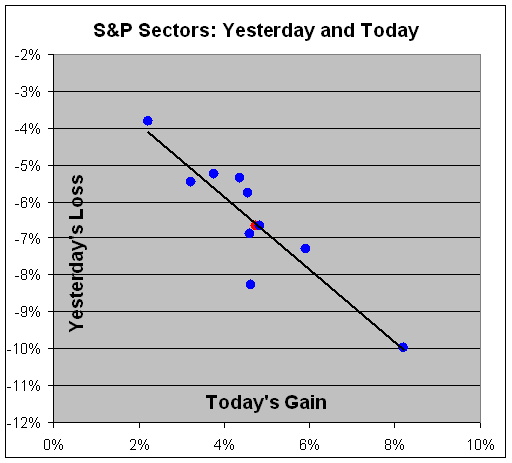
The red dot is the S&P 500. From left to right, the sectors are Staples, Utilities, Healthcare, Telecom, Tech, Industrials, Energy, Discretionary, Materials and Financials.
The one dot that’s closest to being an outlier is the Energy Sector which gained back about 55% of its loss from Monday.
The Market Digests Today’s News
Posted by Eddy Elfenbein on August 9th, 2011 at 3:26 pmHere’s a good example of the market’s reaction to today’s Fed news. I got this from the Wall Street Journal site. It shows the futures for the Fed funds rate for June 2013.
Just a few weeks ago, the market expected the Federal Reserve to have raised rates a few times within the next two years. Now it doesn’t. Note the big jump for today.

Today’s Fed Statement
Posted by Eddy Elfenbein on August 9th, 2011 at 3:06 pmThis is actually a surprising statement. The key is the new language: “The Committee currently anticipates that economic conditions–including low rates of resource utilization and a subdued outlook for inflation over the medium run–are likely to warrant exceptionally low levels for the federal funds rate at least through mid-2013.”
In other words, the economy is going to be sluggish up to, at least, Election Day.
Information received since the Federal Open Market Committee met in June indicates that economic growth so far this year has been considerably slower than the Committee had expected. Indicators suggest a deterioration in overall labor market conditions in recent months, and the unemployment rate has moved up. Household spending has flattened out, investment in nonresidential structures is still weak, and the housing sector remains depressed. However, business investment in equipment and software continues to expand. Temporary factors, including the damping effect of higher food and energy prices on consumer purchasing power and spending as well as supply chain disruptions associated with the tragic events in Japan, appear to account for only some of the recent weakness in economic activity. Inflation picked up earlier in the year, mainly reflecting higher prices for some commodities and imported goods, as well as the supply chain disruptions. More recently, inflation has moderated as prices of energy and some commodities have declined from their earlier peaks. Longer-term inflation expectations have remained stable.
Consistent with its statutory mandate, the Committee seeks to foster maximum employment and price stability. The Committee now expects a somewhat slower pace of recovery over coming quarters than it did at the time of the previous meeting and anticipates that the unemployment rate will decline only gradually toward levels that the Committee judges to be consistent with its dual mandate. Moreover, downside risks to the economic outlook have increased. The Committee also anticipates that inflation will settle, over coming quarters, at levels at or below those consistent with the Committee’s dual mandate as the effects of past energy and other commodity price increases dissipate further. However, the Committee will continue to pay close attention to the evolution of inflation and inflation expectations.
To promote the ongoing economic recovery and to help ensure that inflation, over time, is at levels consistent with its mandate, the Committee decided today to keep the target range for the federal funds rate at 0 to 1/4 percent. The Committee currently anticipates that economic conditions–including low rates of resource utilization and a subdued outlook for inflation over the medium run–are likely to warrant exceptionally low levels for the federal funds rate at least through mid-2013. The Committee also will maintain its existing policy of reinvesting principal payments from its securities holdings. The Committee will regularly review the size and composition of its securities holdings and is prepared to adjust those holdings as appropriate.
The Committee discussed the range of policy tools available to promote a stronger economic recovery in a context of price stability. It will continue to assess the economic outlook in light of incoming information and is prepared to employ these tools as appropriate.
Voting for the FOMC monetary policy action were: Ben S. Bernanke, Chairman; William C. Dudley, Vice Chairman; Elizabeth A. Duke; Charles L. Evans; Sarah Bloom Raskin; Daniel K. Tarullo; and Janet L. Yellen.
Voting against the action were: Richard W. Fisher, Narayana Kocherlakota, and Charles I. Plosser, who would have preferred to continue to describe economic conditions as likely to warrant exceptionally low levels for the federal funds rate for an extended period.
There were three dissensions which is unusually high for a Fed meeting. Yields are soaring and the stock market has given back much of its gains.
Q2 Earnings Summary from Zacks
Posted by Eddy Elfenbein on August 9th, 2011 at 1:26 pmDirk Van Dijk breaks it down:
Almost done with earnings season, with 433 or 86.6% of S&P 500 second quarter results in. Total earnings growth low at 11.2%, but mostly due to one stock (BAC). Ex-Financials, growth is 20.9% year over year. Total revenue growth 12.15%, 12.73% ex-Financials. Median earnings surprise 3.13% and median sales surprise 2.06%. Remaining firms (67) expected to grow 8.9%, 5.4% growth expected excluding Financials.
If remaining firms all report in line, then 87.9% of earnings are now in. Final growth to be 10.95%, 18.80% ex-Financials. At start of earnings season 9.65% growth expected, 12.18% ex-Financials.
Earnings beats top misses by a 3.42 ratio, sales beats top misses by 2.81 ratio, 69.5% of all firms report positive earnings surprise, 72.1% beat on revenues.
Full-year total earnings for the S&P 500 jumps 45.6% in 2010, expected to rise 16.0% further in 2011. Growth to continue in 2012 with total net income expected to rise 11.5%. Financials major earnings driver in 2010. Excluding Financials, growth was 27.7% in 2010, and expected to be 18.8% in 2011 and 10.8% in 2012.
Total revenues for the S&P 500 rose 7.78% in 2010, expected to be up 6.72% in 2011, and 6.54% in 2012. Excluding Financials, revenues up 9.16% in 2010, expected to rise 11.14% in 2011 and 5.96% in 2012.
Annual Net Margins marching higher, from 5.88% in 2008 to 6.40% in 2009 to 8.65% for 2010, 9.34% expected for 2011 and 9.83% in 2012. Margin Expansion major source of earnings growth. Net margins ex-Financials 7.79% in 2008, 7.07% in 2009, 8.27% for 2010, 8.84% expected in 2011, and 9.25% in 2012.
Revisions ratio for full S&P 500 at 1.61 for 2011, at 1.41 for 2012, both bullish readings. Up from last week and driven by new increases, not old estimates falling out. Ratio of firms with rising-to-falling mean estimates at 1.44 for 2011, 1.30 for 2012 — bullish readings. Total revisions activity still climbing, but should peak soon.
The S&P 500 earned $546.5 billion in 2009, rising to $795.4 billion in 2010, expected to climb to $922.2 billion in 2011. In 2012, the 500 are collectively expected to earn $1.028 trillion.
S&P 500 earned $57.20 in 2009: $83.16 in 2010 and $96.47 in 2011 expected, bottom up. For 2012, $107.53 expected. Puts P/Es at 14.4x for 2010 and 12.4x for 2011 and 11.2x for 2012, very attractive relative to 10-year T-note rate of 2.56%. Top-down estimates: $96.26 for 2011 and $105.44 for 2012.
Greg Mankiw & Bill Poole Talk Fed
Posted by Eddy Elfenbein on August 9th, 2011 at 12:20 pmGreat News! A Very, Very Modest Bounce
Posted by Eddy Elfenbein on August 9th, 2011 at 11:21 am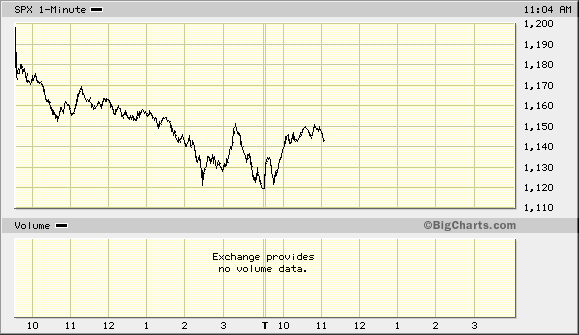
-
Archives
- October 2026
- September 2026
- August 2026
- July 2026
- June 2026
- May 2026
- April 2026
- March 2026
- February 2026
- January 2026
- December 2025
- November 2025
- October 2025
- September 2025
- August 2025
- July 2025
- June 2025
- May 2025
- April 2025
- March 2025
- February 2025
- January 2025
- December 2024
- November 2024
- October 2024
- September 2024
- August 2024
- July 2024
- June 2024
- May 2024
- April 2024
- March 2024
- February 2024
- January 2024
- December 2023
- November 2023
- October 2023
- September 2023
- August 2023
- July 2023
- June 2023
- May 2023
- April 2023
- March 2023
- February 2023
- January 2023
- December 2022
- November 2022
- October 2022
- September 2022
- August 2022
- July 2022
- June 2022
- May 2022
- April 2022
- March 2022
- February 2022
- January 2022
- December 2021
- November 2021
- October 2021
- September 2021
- August 2021
- July 2021
- June 2021
- May 2021
- April 2021
- March 2021
- February 2021
- January 2021
- December 2020
- November 2020
- October 2020
- September 2020
- August 2020
- July 2020
- June 2020
- May 2020
- April 2020
- March 2020
- February 2020
- January 2020
- December 2019
- November 2019
- October 2019
- September 2019
- August 2019
- July 2019
- June 2019
- May 2019
- April 2019
- March 2019
- February 2019
- January 2019
- December 2018
- November 2018
- October 2018
- September 2018
- August 2018
- July 2018
- June 2018
- May 2018
- April 2018
- March 2018
- February 2018
- January 2018
- December 2017
- November 2017
- October 2017
- September 2017
- August 2017
- July 2017
- June 2017
- May 2017
- April 2017
- March 2017
- February 2017
- January 2017
- December 2016
- November 2016
- October 2016
- September 2016
- August 2016
- July 2016
- June 2016
- May 2016
- April 2016
- March 2016
- February 2016
- January 2016
- December 2015
- November 2015
- October 2015
- September 2015
- August 2015
- July 2015
- June 2015
- May 2015
- April 2015
- March 2015
- February 2015
- January 2015
- December 2014
- November 2014
- October 2014
- September 2014
- August 2014
- July 2014
- June 2014
- May 2014
- April 2014
- March 2014
- February 2014
- January 2014
- December 2013
- November 2013
- October 2013
- September 2013
- August 2013
- July 2013
- June 2013
- May 2013
- April 2013
- March 2013
- February 2013
- January 2013
- December 2012
- November 2012
- October 2012
- September 2012
- August 2012
- July 2012
- June 2012
- May 2012
- April 2012
- March 2012
- February 2012
- January 2012
- December 2011
- November 2011
- October 2011
- September 2011
- August 2011
- July 2011
- June 2011
- May 2011
- April 2011
- March 2011
- February 2011
- January 2011
- December 2010
- November 2010
- October 2010
- September 2010
- August 2010
- July 2010
- June 2010
- May 2010
- April 2010
- March 2010
- February 2010
- January 2010
- December 2009
- November 2009
- October 2009
- September 2009
- August 2009
- July 2009
- June 2009
- May 2009
- April 2009
- March 2009
- February 2009
- January 2009
- December 2008
- November 2008
- October 2008
- September 2008
- August 2008
- July 2008
- June 2008
- May 2008
- April 2008
- March 2008
- February 2008
- January 2008
- December 2007
- November 2007
- October 2007
- September 2007
- August 2007
- July 2007
- June 2007
- May 2007
- April 2007
- March 2007
- February 2007
- January 2007
- December 2006
- November 2006
- October 2006
- September 2006
- August 2006
- July 2006
- June 2006
- May 2006
- April 2006
- March 2006
- February 2006
- January 2006
- December 2005
- November 2005
- October 2005
- September 2005
- August 2005
- July 2005
 Eddy Elfenbein is a Washington, DC-based speaker, portfolio manager and editor of the blog Crossing Wall Street. His