Author Archive
-
Morning News: February 19, 2020
Eddy Elfenbein, February 19th, 2020 at 7:09 amIn Coronavirus Fight, China Sidelines An Ally: Its Own People
Chinese Companies Say They Can’t Afford to Pay Workers Now
Apple Is Handcuffed to the iPhone. Just Like Its Customers
Puma Chief Puts Brave Face on Coronavirus Retail Crisis
Cruise Giant Carnival Works to Manage Deepening Coronavirus Crisis
Fed’s Balance Sheet Dominates What to Watch For in FOMC Minutes
An Economist’s Guide to Spending Bezos’s Billions on Climate Change
The Future Of Battery Energy Storage Is Upon Us
Tesla Solar Roof Superfans Face Long Waits, Install Times
Bed Bath & Beyond Boss Tries to Declutter Stores
Wine is Expected to Get a Lot More Affordable Due To An Oversupply of California Grapes
Nick Maggiulli: Avoid the Zeros
Joshua Brown: Rooting for a Correction
Howard Lindzon: Amazon Keeps On Chugging…And The Space Bubble
Ben Carlson: The Biggest Problem in Finance?
Be sure to follow me on Twitter.
-
Apple Warns on Virus
Eddy Elfenbein, February 18th, 2020 at 11:22 amYesterday, the financial world got a bit of a shock when Apple (AAPL) warned that due to the coronavirus, they won’t hit their revenue targets for fiscal Q2.
They didn’t provide new numbers; they just said they won’t hit the old ones. Shares of Apple are down a bit today along with some big-name tech stocks. When you’re worth $1.4 trillion, anything you say will get attention.
Not much news on our Buy List. I see that Globe Life (GL), Ross Stores (ROST) and Silgan (SLGN) are all at new highs this morning.
Middleby (MIDD) finally said when it will report its earnings. The date is February 26.
-
Morning News: February 18, 2020
Eddy Elfenbein, February 18th, 2020 at 7:05 amChina to Grant Tariff Exemptions on 696 U.S. Goods to Support Purchases
China Races to Contain Job Losses As Coronavirus Batters Economy
Pessimistic Outlook in Russia Slows Investment, and the Economy
Fed Doesn’t Want Another Repo Crisis, But Treasury Isn’t Helping
How Millennials Could Make the Fed’s Job Harder
Apple Shares Drop After Virus Warning Rattles Tech Investors
Exclusive Details on Michael Bloomberg’s Plan to Rein in Wall Street
Franklin Resources Nears Deal to Buy Legg Mason
A Giant Milk Industry Merger Moves Closer With a $425 Million Deal
Tesla Bear Morgan Stanley Raises Its Bull Case to $1,200 a Share
Pier 1 Imports, the Struggling Home Goods Retailer, Files for Bankruptcy
HSBC Holdings Profit Plunges 53%, Will Suspend Buybacks amid Revamp
Michael Batnick: A Random Watch Down Wall Street: Margin Call
Ben Carlson: The Biggest Wealth Levers & Some Lessons From 92 Years of Market Return Data
Jeff Carter: Investing, Just Do It & VC: Godlike or Service Industry?
Be sure to follow me on Twitter.
-
Morning News: February 17, 2020
Eddy Elfenbein, February 17th, 2020 at 7:07 amJapan’s Economy Shrank Sharply. Now Comes the Coronavirus.
Slowed by the Coronavirus, China Inc. Struggles to Reopen
Trump Effort to Keep U.S. Tech Out of China Alarms American Firms
Lebanon Warned of Implosion as IMF, World Bank Plead for Reforms
Dubai’s Massive Port Operator DP World is Delisting and Returning to Private Ownership
GM Shuts Australia, NZ Operations; Sells Thai Plant to Great Wall
Clock’s Ticking for Nissan Boss Uchida to Show He Has a Plan
Alstom in Talks for $7 Billion Buyout of Bombardier Train Unit
New York Drops Fight Against T-Mobile-Sprint Merger
Facebook Needs Regulation to Win User Trust, Zuckerberg Says
Crazy Mascots Flooded Japan. Can This Grouchy Boar Survive?
Jeff Miller: Is It Too Late to Invest in Housing Stocks?
Cullen Roche: Three Things I Think I Think – Bubbles, Bernie & the Recliners
Roger Nusbaum: You Need More Optionality, Not Less
Howard Lindzon: Another E-Commerce Aha Moment….And Amazon Should Still Buy Twitter
Be sure to follow me on Twitter.
-
CWS Market Review – February 14, 2020
Eddy Elfenbein, February 14th, 2020 at 7:08 am“Employment gains have been broad based across all racial and ethnic groups and levels of education. Wages have been rising, particularly for lower-paying jobs.”
– Fed Chairman Jerome PowellA month ago, the daily moves on the stock market were largely determined by whether or not we had good news on the trade front. An optimistic news story could send stocks higher, while a pessimistic take could cause stocks to sour.
Over the last few weeks, that dynamic has been replaced by news on the coronavirus. I think this is a good instance of Wall Street traders looking for excuses to do what they already intended. That’s not uncommon.
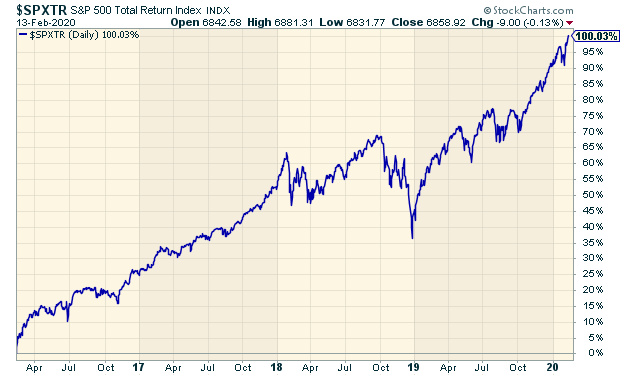
The good news is that Wall Street had been inching higher of late. On Wednesday, the S&P 500 rallied for the seventh time in eight days to close at another all-time high. The index is already up 4.4% this year.
This has been a remarkable rally. Four years ago this week, on February 11 to be precise, the S&P 500 closed at a near-term low of 1,829. It’s been a vigorous rally ever since. In fact, if you look at the S&P 500 Total Return Index, which includes dividends, it shows that the stock market has almost exactly doubled in four years and two days.
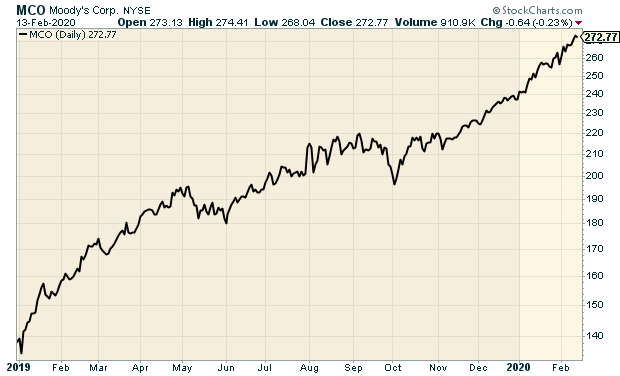
Our Buy List stocks are joining in the fun. Moody’s is our #1 performer so far this year with a gain of more than 14%. The ratings agency just delivered another outstanding earnings report. I’ll have the details in a bit.
We also have double-digit gains in some of our newbies this year, like Ansys (ANSS) and Trex (TREX). Later on, I’ll preview the upcoming earnings reports from Stepan (SCL) and Hormel Foods (HRL). But first, let’s look at some recent economic news.
Make Sure You Own Some Defensive Stocks
With the troubling news of the coronavirus, there’s been some speculation that the Federal Reserve may cut interest rates. This is interesting because not that long ago, market watchers didn’t see the Fed making any moves before election day. Frankly, I’m still a doubter.
Fed Chairman Jerome Powell testified before Congress this week. This is part of his semi-annual Humphrey-Hawkins testimony. In this week’s epigraph, I included an interesting statement from the Fed Chairman on the state of the labor market. This is very encouraging news.
Last week’s strong jobs report was also a good indicator that the Fed is happy with interest rates right where they are. I like to watch the two-year Treasury yield because it’s often a good indicator of what the Fed will do. The two-year yield did dip below 1.35% recently, but it’s come up some. I think the Fed wants to avoid the appearance that they’ll come running to the rescue any time the market hiccups.
Another point in the Fed’s favor was this week’s timid inflation report. On Thursday, the government said that consumer prices rose just 0.1% last month. The “core rate,” which excludes food and energy prices, rose by 0.2%.
The Fed’s recent rate cuts were clearly good for the economy, and that’s what the market is responding to. Going forward, however, I urge caution. Defensive stocks got left behind late last year. They came alive again in January, but February has been rough. I think we’ll see more defensive stocks do well later this year.
By defensive, I mean consumer staples like Hershey (HSY) or Church & Dwight (CHD). In a bit, I’ll preview the upcoming earnings report from Hormel Foods (HRL), a classic defensive stock.
You also want to make sure you have several dividend payers in your portfolio. There are several good candidates on our Buy List. Dividend-paying stocks have become popular again. In fact, more than 70% of the weighting of the S&P 500 is comprised of dividend payers. That’s the highest percentage since the 1920s.
Fortunately, Wall Street still sees decent earnings growth for this year. At the start of the year, analysts had been expecting earnings growth of 9.6%. That’s been trimmed back to 8.1%. It’s still a lot better than the 1.7% we got for 2019.
Now let’s look at the strong earnings report from Moody’s.
Moody’s Is a Buy Up to $288 per Share
On Wednesday, Moody’s (MCO) released fourth-quarter earnings of $2.00 per share. That’s up 23% over last year. It also topped Wall Street’s forecast by seven cents per share.
This was a solid quarter for Moody’s. Revenues rose 16% to $1.2 billion. For the year, Moody’s earned $8.29 per share. That’s an increase of 12% over 2018. In business, the only thing better than a monopoly is a pseudo-monopoly (folks tend to notice the first). In particular, I’m a big fan of Moody’s Analytics.
I also like that Moody’s is rewarding its shareholders. During 2019, Moody’s bought back 5.2 million shares at a cost of $991 million. The company is also bumping up its dividend by 12% to 56 cents per share. The dividend will be payable on March 18 to stockholders of record at the close of business on February 25.
Now let’s look at guidance. For 2020, Moody’s expects earnings to range between $9.10 and $9.30 per share. That’s quite good. I was actually expecting something more conservative. I think Moody’s can hit $10 per share next year.
The shares dropped at the open but then quickly reversed course. The stock has been a strong performer for us. Since early October, MCO has gained nearly 40%. Don’t be surprised to see Moody’s lag for a bit. Nothing’s wrong. We just have to keep our feet on the ground even when traders aren’t. This week, I’m lifting my Buy Below on Moody’s to $288 per share.
Two Earnings Reports Next Thursday
We have two more reports next Thursday. Stepan (SCL), one of our new stocks, is due to report before the market opens. Stepan makes specialty and intermediate chemicals. The company has been in business for 82 years, and it’s still barely known. Actually, I kind of like that. Stepan is followed by just two analysts on Wall Street.
Although Stepan is classified with other specialty-chemical companies, it’s unique in the industry. Stepan doesn’t have a competitor that precisely matches its businesses. It makes surfactants, which are the key ingredient in consumer and industrial cleaning compounds. That includes things like detergents, fabric softeners, shampoos, and lotions. Surfactants make them clean and foam.
Stepan also makes germicidal quaternary compounds. That’s a scary name for products that kill germs, mold, and mildew. Hospitals and restaurants depend on these products for the safety and hygiene of their premises.
Stepan also has a polymer group. This is for plastics and polyester products. Think of a laminate board for the construction industry plus coatings, adhesives, and sealants. Stepan has about 2,000 employees.
In October, Stepan raised its dividend by 10% to 27.5 cents per share which works out to $1.10 per share for the year. This was Stepan’s 52nd annual dividend increase in a row. That’s a remarkable streak. There are very few companies that have longer streaks than that. Speaking of which….
Also on Thursday, Hormel Foods (HRL) is due to report. Hormel is one of our off-cycle stocks. Their quarter ends at the end of January. Since they tend to report early, their fiscal Q1 report blends in when other companies are reporting their Q4 results.
Three months ago, Hormel said they made 47 cents per share. That was a penny better than estimates. For the entire fiscal year, Hormel made $1.80 per share. For 2020, Hormel sees sales ranging between $9.5 billion and $10 billion and EPS between $1.69 and $1.83. For Q1, Wall Street expects 45 cents per share.
In November, Hormel also raised its annual dividend from 84 cents to 93 cents per share. That was the 54th year in a row that the Spam people have increased their dividend. Yes, we found one even longer than Stepan!
Buy List Updates
Coming the week after next, we’ll get earnings from Trex (TREX) and Ansys (ANSS). We should also hear from Middleby (MIDD), but they haven’t given us an earnings date yet.
I also want to make changes to our Buy Below prices. I’m raising the Buy Below of FactSet (FDS) to $304 per share. The next earnings report will be due out in late March.
I’m also cutting my Buy Below on Eagle Bancorp (EGBN) to $48 per share.
That’s all for now. The stock market will be closed on Monday for George Washington’s birthday (technically, the NYSE celebrates Washington’s birthday, not President’s Day.) On Wednesday, the Fed will release the minutes from their last meeting. Also on Wednesday, we’ll get the latest housing-starts report. Then on Friday, the report on existing-home sales is due out. Be sure to keep checking the blog for daily updates. I’ll have more market analysis for you in the next issue of CWS Market Review!
– Eddy
-
Morning News: February 14, 2020
Eddy Elfenbein, February 14th, 2020 at 7:02 amGerman Economy Looks Ill-Prepared for What’s Coming in 2020
U.S. Accuses Huawei of Stealing Trade Secrets, Assisting Iran
Judge Halts Work on Microsoft’s JEDI Contract, a Victory for Amazon
SEC Subpoenas Financial Records From Tesla in New Probe
Zuckerberg Ready for Facebook to Pay More Tax as Welcomes Rules Review
Airbnb to America’s Big Cities: See You in Court
As Boeing Jets Sit Idle, Airbus Can’t Make Planes Fast Enough
Climate Skeptic Asset Managers Face Pressure to Reveal Donations
BP Beefs Up Carbon Capture Team in Bid to Meet Climate Goals
Motorola’s $1,500 Razr Reboot Feels More Prototype Than Premium
T-Mobile Parent Deutsche Telekom Seeking To Renegotiate Price Of Sprint Merger
Build Build Build Build Build Build Build Build Build Build Build Build Build Build
Ben Carlson: The Biggest Risk in Crypto Today
Michael Batnick: When You Were Born > Everything Else
Joshua Brown: What New Investors Should Focus On
Be sure to follow me on Twitter.
-
Tesla to Raise $2 Billion from a Stock Offering
Eddy Elfenbein, February 13th, 2020 at 9:10 amShares of Tesla (TSLA) are down a few dollars this morning after the company said it will float $2 billion in stock.
I have a simple rule in these matters. A company may raise as much as they can get away with. By this I mean, raise as much to the point that it won’t hurt their stock.
Outside of a few percentage points today, shares of Tesla have rallied spectacularly since June. As such, it’s completely responsible to raise money from new investors. If people want to overpay for your stock, the company has every right to benefit from that.
On this issue, I’m a complete pragmatist. Companies shouldn’t worry about what economic models say. If the market is cool with it, then you’re right. If it’s not, then you’re wrong.
I wouldn’t be surprised if Tesla closes up today.
By the way, this raises an interesting theoretical point. If we view the market as a contest between a stock’s market price and its true underlying value, what Tesla is doing blurs that line.
An overvalued company can use its rich stock price to raise more capital which in turn raises its true underlying value. In turn, that can raise the share price.
During the dot-com bubble, we saw empty companies use their exalted share prices as currency to buy other empty companies. This was a great strategy, until it wasn’t.
-
Modest Inflation for January
Eddy Elfenbein, February 13th, 2020 at 8:56 amThis morning, the government said that consumer prices rose 0.1% last month after increasing by 0.2% for the prior three months.
The “core rate,” which excludes food and energy prices, rose by 0.2%. Or to be somewhat more precise, 0.2423%. In the last 12 months, the core CPI is up 2.3%.
In January, gasoline prices fell 1.6% after jumping 3.1% in December. Food prices gained 0.2%, matching December’s increase. Food consumed at home ticked up 0.1%.
Owners’ equivalent rent of primary residence, which is what a homeowner would pay to rent or receive from renting a home, increased 0.3% after rising 0.2% for two consecutive months. The shelter index rose 0.4% after climbing 0.2% in December.Healthcare costs rose 0.2% last month after surging 0.5% in December. Apparel prices jumped 0.7% after increasing 0.1% in December. But new vehicle prices were unchanged in January after rebounding 0.1% in the prior month. Prices for used motor vehicles and trucks fell 1.2% after decreasing 0.4% in December.
We also learned this morning that initial jobless claims rose by 2,000 to 205,000. That’s still very low. Last week, claims were 203,000 which was the lowest since November.
There are still two Fed vacancies. Trump has appointed Christopher Waller and Judy Shelton. Waller is a conventional choice, but Shelton is controversial. (Gold standard et al.) Both will appear before the Senate Banking Committee today.
-
Morning News: February 13, 2020
Eddy Elfenbein, February 13th, 2020 at 7:10 amIran’s Economy Is Bleak. Its Stock Market Is Soaring.
Jump in Coronavirus Cases Yanks Rally Into Reverse
IEA Sees First Global Oil Demand Drop in a Decade
With Harsh Words, China’s Military Denies It Hacked Equifax
Retirement Millionaire Crowd Swells to Record in Roaring Market
A Wall St. Giant Says Sanders Would ‘Ruin’ the Economy
Despite $1 Trillion Deficits, Trump Tax Cuts Will Still ‘Pay For Themselves’: Mnuchin
Andy Rubin’s Start-Up, Essential Products, Shuts Down
Investment Bank Loss Mars Thiam’s Final Act at Credit Suisse
James Staley, Barclays C.E.O., Faces U.K. Probe on Jeffrey Epstein Ties
MGM Resorts CEO Jim Murren Departing Casino Company
Jeff Bezos Buys David Geffen’s Los Angeles Mansion for a Record $165 Million
Joshua Brown: The Bull Market for Financial Advisors
Ben Carlson: Animal Spirits: Everybody’s Trading
Michael Batnick: How We Measure Performance
Be sure to follow me on Twitter.
-
Moody’s Beats Earnings and Raises Dividend
Eddy Elfenbein, February 12th, 2020 at 11:15 amThis morning, Moody’s (MCO) released fourth-quarter earnings of $2.00 per share. That’s up 23% over last year. It also topped Wall Street’s forecast by seven cents per share. Revenues rose 16% to $1.2 billion. For the year, Moody’s earned $8.29 per share. That’s an increase of 12% over 2018. These numbers are very, very good.
“Moody’s revenue growth for full year 2019 was the result of strong contributions from both Moody’s Analytics and Moody’s Investors Service. Robust performance at Moody’s Analytics was driven by increasing customer demand for core research and data products, along with compliance and know-your-customer solutions. Additionally, Moody’s Investors Service benefited from increased global bond issuance amid generally favorable market conditions,” said Raymond McDaniel, President and Chief Executive Officer of Moody’s. “For 2020, we expect to continue leveraging the capabilities of our core businesses, further innovate with new technologies and capitalize on strategic investments, such as our recently announced acquisition of Regulatory DataCorp.”
During 2019, Moody’s bought back 5.2 million shares for a cost of $991 million. The company is also bumping up its dividend by 12% to 56 cents per share.
The dividend will be payable on March 18 to stockholders of record at the close of business on February 25.
For 2020, Moody expect earnings to range between $9.10 and $9.30 per share.
-
Archives
- July 2026
- June 2026
- May 2026
- April 2026
- March 2026
- February 2026
- January 2026
- December 2025
- November 2025
- October 2025
- September 2025
- August 2025
- July 2025
- June 2025
- May 2025
- April 2025
- March 2025
- February 2025
- January 2025
- December 2024
- November 2024
- October 2024
- September 2024
- August 2024
- July 2024
- June 2024
- May 2024
- April 2024
- March 2024
- February 2024
- January 2024
- December 2023
- November 2023
- October 2023
- September 2023
- August 2023
- July 2023
- June 2023
- May 2023
- April 2023
- March 2023
- February 2023
- January 2023
- December 2022
- November 2022
- October 2022
- September 2022
- August 2022
- July 2022
- June 2022
- May 2022
- April 2022
- March 2022
- February 2022
- January 2022
- December 2021
- November 2021
- October 2021
- September 2021
- August 2021
- July 2021
- June 2021
- May 2021
- April 2021
- March 2021
- February 2021
- January 2021
- December 2020
- November 2020
- October 2020
- September 2020
- August 2020
- July 2020
- June 2020
- May 2020
- April 2020
- March 2020
- February 2020
- January 2020
- December 2019
- November 2019
- October 2019
- September 2019
- August 2019
- July 2019
- June 2019
- May 2019
- April 2019
- March 2019
- February 2019
- January 2019
- December 2018
- November 2018
- October 2018
- September 2018
- August 2018
- July 2018
- June 2018
- May 2018
- April 2018
- March 2018
- February 2018
- January 2018
- December 2017
- November 2017
- October 2017
- September 2017
- August 2017
- July 2017
- June 2017
- May 2017
- April 2017
- March 2017
- February 2017
- January 2017
- December 2016
- November 2016
- October 2016
- September 2016
- August 2016
- July 2016
- June 2016
- May 2016
- April 2016
- March 2016
- February 2016
- January 2016
- December 2015
- November 2015
- October 2015
- September 2015
- August 2015
- July 2015
- June 2015
- May 2015
- April 2015
- March 2015
- February 2015
- January 2015
- December 2014
- November 2014
- October 2014
- September 2014
- August 2014
- July 2014
- June 2014
- May 2014
- April 2014
- March 2014
- February 2014
- January 2014
- December 2013
- November 2013
- October 2013
- September 2013
- August 2013
- July 2013
- June 2013
- May 2013
- April 2013
- March 2013
- February 2013
- January 2013
- December 2012
- November 2012
- October 2012
- September 2012
- August 2012
- July 2012
- June 2012
- May 2012
- April 2012
- March 2012
- February 2012
- January 2012
- December 2011
- November 2011
- October 2011
- September 2011
- August 2011
- July 2011
- June 2011
- May 2011
- April 2011
- March 2011
- February 2011
- January 2011
- December 2010
- November 2010
- October 2010
- September 2010
- August 2010
- July 2010
- June 2010
- May 2010
- April 2010
- March 2010
- February 2010
- January 2010
- December 2009
- November 2009
- October 2009
- September 2009
- August 2009
- July 2009
- June 2009
- May 2009
- April 2009
- March 2009
- February 2009
- January 2009
- December 2008
- November 2008
- October 2008
- September 2008
- August 2008
- July 2008
- June 2008
- May 2008
- April 2008
- March 2008
- February 2008
- January 2008
- December 2007
- November 2007
- October 2007
- September 2007
- August 2007
- July 2007
- June 2007
- May 2007
- April 2007
- March 2007
- February 2007
- January 2007
- December 2006
- November 2006
- October 2006
- September 2006
- August 2006
- July 2006
- June 2006
- May 2006
- April 2006
- March 2006
- February 2006
- January 2006
- December 2005
- November 2005
- October 2005
- September 2005
- August 2005
- July 2005
 Eddy Elfenbein is a Washington, DC-based speaker, portfolio manager and editor of the blog Crossing Wall Street. His