-
IBM News
Posted by Eddy Elfenbein on October 19th, 2014 at 5:59 pmIBM ($IBM) is due to report its earnings tomorrow. The company just released this cryptic statement:
ARMONK, N.Y.–(BUSINESS WIRE)–
IBM (IBM) will make a major business announcement and separately release its third-quarter 2014 earnings results on Monday, October 20 at 7:00 a.m. EDT.
Martin Schroeter, IBM senior vice president and chief financial officer, will host the company’s quarterly earnings conference call on Monday, October 20 beginning at 8:00 a.m. EDT.
The Webcast may be accessed via a link at http://www.ibm.com/investor/events/earnings/3q14.html.
Now Bloomberg is reporting that IBM is paying Globalfoundries Inc. $1.5 billion to take on their money-losing chip-making business.
IBM will also receive $200 million worth of assets, making the net value of the deal $1.3 billion, said the people who asked not to be identified because the plan is private. The companies plan to announce the deal tomorrow morning, the people said. IBM put out a statement today saying it planned to make a “major business announcement” tomorrow at 7 a.m. New York time.
After months of on-again, off-again talks, IBM Chief Executive Officer Ginni Rometty struck a deal to jettison the chipmaking unit, which has been a drag on earnings. Globalfoundries, owned by an investment arm of the government of Abu Dhabi, is taking on the unit to tap the expertise of its engineers in the fundamentals of semiconductor design and manufacturing.
-
CWS Market Review – October 17, 2014
Posted by Eddy Elfenbein on October 17th, 2014 at 7:09 amOur job is to find a few intelligent things to do, not to keep
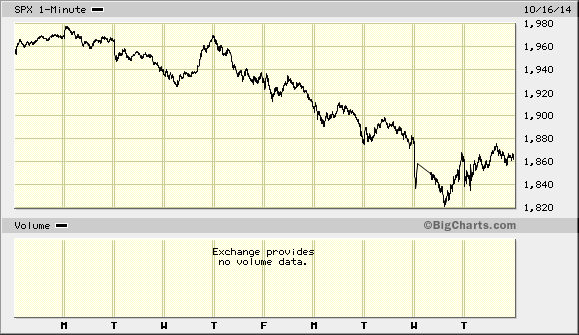
up with every damn thing in the world.” – Charlie MungerGood advice, Charlie. Unfortunately, every damn thing in the world and then some has been on Wall Street’s mind lately. This has been the most dramatic week for the stock market all year. On Monday, the S&P 500 broke below its 200-day moving average for the first time in nearly two years. That gave the bears a lot more confidence to do more damage.
On Wednesday, the market dropped sharply at the open, then bounced back, then fell even lower, and then rallied even stronger. Remember how laid back and peaceful everything was this summer? Well, not anymore. I guess weird things happen on Wall Street in October. In just one week, the Volatility Index (VIX) doubled. At one point on Wednesday, the S&P 500 got as low as 1,820.66, and the Dow fell below 16,000.
As febrile as the stock market was, the bond market was even crazier. The yield on the ten-year Treasury fell below 2% this week. At one point on Wednesday, it dipped below 1.9%. At the start of the year, the ten-year was yielding 3%. (Note that this will eventually be a big help for the slumbering housing market.)
What’s causing the market to be such a drama queen? That’s simple. It’s the three E’s—earnings, Europe and Ebola. Some are real concerns (like Europe), and some are not (like Ebola). I think traders saw an opportunity to panic since everything had been so calm for so long. It was probably the dramatic impact of the strong dollar that first unnerved traders. Then once Ebola came into the news, they had their chance to panic, and they took it. Beware: Bearish sentiment can be spread through the air—or even by casual contact.
As usual, we don’t pay attention to the madding crowd. Instead, we focus on facts, and that means earnings. This week, we got three decent earnings reports from our Buy List stocks, although the guidance was fairly tepid. I’ll run through the details in a bit. I’ll also preview six Buy List earnings reports coming our way next week. We’re heading right into the heart of earnings season. But first, let’s take a closer look at the three E’s.
Riding out the October Storm
I’m not a close follower of chart patterns or technical analysis, but I do like to keep an eye on the stock market’s 200-day moving average. This is simply the average of the S&P 500 over the last 200 trading days (roughly ten months).
I’ve crunched the numbers, and it’s true: the S&P 500 does much better when it’s above its 200-DMA than when it’s below it. Since 1933, the S&P 500 has averaged an 11% annualized gain when it’s sitting above its 200-DMA, compared with a 1% annualized loss when it’s below.
Why does the 200-DMA seem to work? I think it’s a good example of a dumb rule that works well for complex reasons. The stock market tends to be very sensitive to trends. Once it gets going in one direction, it tends to stay there. The hard part, of course, is picking the turning points. These can be sharp and unexpected. The 200-DMA seems to capture the sweet spot in that it’s long enough to identify the trend, yet short enough to capture turning points.
You can see how going below the 200-DMA changed sentiment by looking at what happened on Thursday. We got the best initial jobless claims report in 14 years. It was the second-best report in 40 years. Yet traders continued to panic over the Ebola news. I’m certainly no expert in public health, but those who are continuing to maintain this hysteria are absurd.
As we know, the market likes to sell first and ask questions later. For example, airline stocks have plunged in response to Ebola. Shares of Southwest Airlines (LUV) dropped 20% in less than a month. Clorox (CLX) said that sales of disinfectants are up 28% in the last month.
I think the market’s panic reached a peak on Wednesday when the Volatility Index hit 31. I expect to see this slide downward next week. This may sound contradictory, but the stock market’s most manic phase usually comes before the lowest share prices are reached. For example, Wall Street’s volatility peaked in the fall of 2008, even though stocks continued to meander lower for another six months. Despite the lower share prices, by March 2009, other market measures such as the VIX or the TED Spread had calmed down dramatically. This pattern is very typical.
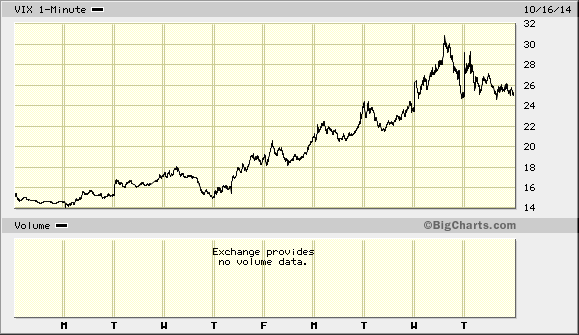
I wouldn’t be surprised to see the S&P 500 fall to near 1,800 soon, but I strongly suspect that most of the damage has already been done. That’s one of the characteristics of a selloff: Once you realize what’s happening, most of it has already passed. The economy’s fundamentals are quite solid. Q3 Earnings season is still young, but analysts expect earnings growth of 4.8% and sales growth of 4.2%. That’s not blistering, but it’s far from a recession.The strong dollar continues to make its presence felt. The price of oil dropped below $80 per barrel this week. It seems that Saudi Arabia is perfectly willing to let the price fall. They have no intention of cutting back production. Perhaps it’s a challenge to Russia. Perhaps they want to show American shale producers who’s boss. Perhaps they have no choice, since Europe is weak. Whatever the reason, the price of oil is down and may go even lower. That’s good for consumers, but not so good for domestic producers. Americans aren’t used to thinking of themselves as big-time energy producers.
The strong dollar is also putting the squeeze on inflation. James Bullard, the head of the St. Louis Fed, said this week that the Federal Reserve ought to reconsider ending its bond-buying program. Even though the labor market appears to be getting better, workers aren’t getting higher wages. Also, inflation expectations have fallen, and getting inflation up to 2% is the Fed’s target.
Inflation expectations, as measured by the five-year “breakeven” rate, have dropped substantially. Three months ago, the bond market expected inflation to be 1.96% over the coming five years. Now that’s down to 1.37%. I see Bullard’s point, but I don’t think there’s anything like a majority within the Fed to keep buying bonds. But I think it’s very possible that the Fed will hold off on any rate increase until late 2015, or even 2016. The yield on the two-year Treasury is down 20 basis points in the last two weeks. That’s probably the maturity that’s most sensitive to changes in the Fed’s outlook. We’re living in a low-rate world.
Investors shouldn’t get rattled by this latest selling. Although the market is down, the relative performance of our Buy List has improved a great deal this month. That’s because investors flock towards high-quality stocks when things get scary. With Ebola, I urge calm. With Europe, I urge patience. And with earnings, I urge you to focus on quality. Now let’s take a look at our recent earnings reports.
Wells Fargo Earns $1.02 per Share
Wells Fargo (WFC) kicked off earnings season for our Buy List. The big bank reported Q3 earnings of $1.02 per share, which matched expectations. Digging in the details, the bank was helped out by a gain in venture capital and lower-than-expected taxes. Without that, they would have missed earnings. But on the plus side, WFC’s quarterly revenue rose to $21.21 billion, which topped expectations.
Frankly, this is a difficult time for the banking sector, since mortgage activity has dried up. Make no mistake, Wells is doing just fine. They’re the best-run big bank in America. I’m also pleased to see that WFC’s “underperforming” loans are getting smaller. They’re well capitalized and can weather any storm.
Unfortunately, one thing Wells isn’t protected against is a rash of selling. WFC dropped below $46 on Wednesday, which is a very attractive price. The stock is currently going for less than 12 times this year’s earnings. That’s a bargain, but it will take a calmer market for Wells to rally. This is a keeper. Wells Fargo is a buy up to $54 per share.
eBay Drops below $48 per Share
After the bell on Wednesday, eBay (EBAY) reported Q3 earnings of 68 cents per share. That was one penny more than expectations. Three months ago, the online auction house gave us a range of 65 to 67 cents per share, so they’re running ahead of their own guidance. Quarterly revenue rose 12% to $4.4 billion, which was slightly better than expectations.
From the press release:
“Rapidly changing competitive environments in commerce and payments underscore the opportunities for eBay and PayPal and highlight how each business will benefit from the focus and agility of being an independent company,” said eBay Inc. President and CEO John Donahoe. “PayPal had another strong quarter, and its mobile-payments leadership and momentum continued, with mobile volume up 72 percent to $12 billion. PayPal is on track to process 1 billion mobile transactions in 2014. And eBay continues to focus on enhancing its competitive position, improving the experience for buyers and sellers and investing in consumer engagement. As we prepare to separate eBay and PayPal in 2015, our teams are focused on strong execution to ensure each business is set up for long-term success.”
Guidance was blah (to use a technical term). For Q4, eBay expects earnings to come in between 88 and 91 cents per share. Wall Street had been expecting 91 cents per share. The company expects Q4 revenue of $4.85 billion to $4.95 billion. That raised an eyebrow. Wall Street had $5.16 billion.
eBay lowered their full-year revenue guidance to $17.85 billion to $17.95 billion. The old guidance was $18.0 billion to $18.3 billion. They made no comment about full-year earnings guidance, so I’m assuming the previous guidance of $2.95 to $3.00 per share still holds. The stock got sacked for a 4.7% loss on Thursday. That hardly seems commensurate for a company that hasn’t altered its earnings forecast. Stick with this one; eBay is a buy up to $55 per share.
Stryker Is a Buy up to $87
On Thursday, Stryker (SYK) reported Q3 earnings of $1.15 per share, which was a penny ahead of expectations. They had said to expect earnings between $1.12 and $1.16 per share. Like so many other companies, Stryker has felt the impact of the strong U.S. dollar. Unfortunately, Stryker said they expect full-year earnings to be at the low end of their previous guidance, which was $4.75 to $4.80 per share.
That’s still a healthy profit. I don’t get too worried about issues of exchange rates because that can happen to anyone. The good news is that Stryker continues to see organic sales rising by 5% to 6%. For the quarter, revenue rose 11% to 2.39 billion, which beat expectations by $70 million. Stryker is an ideal buy-and-hold stock. SYK is a buy up to $87 per share.
Six Buy List Earnings Reports Next Week
Next week, we have six Buy List earnings reports coming out. Here’s a rundown:
IBM (IBM) is due to report on Monday. Frankly, the company’s business has been rather lackluster of late, but large-scale buybacks have greatly aided Big Blue’s earnings-per-share. Wall Street currently expects Q3 earnings of $4.32 per share. That may be a bit too high, but I want to see how their business units are faring under the stronger dollar.
McDonald’s (MCD) is due to report on Tuesday. The burger giant is working to turn itself around, and that’s taking longer than I had anticipated. On Thursday, the shares hit a fresh 52-week low. Thanks to the lower share price, the yield on MCD is up to 3.78%. The stock is cheap here, but I want to see concrete evidence that things are getting better.
On Wednesday, CA Technologies (CA) is due to report. The company was one of the bright spots last earnings season. Shares of CA jumped after they beat earnings by five cents per share, but the stock hasn’t done well since then. They also touched a 52-week low on Thursday, and yield is now close to 4%. I’m not sure what more the market expects from them.
CR Bard (BCR) will report on Wednesday, and like CA, Bard also had an impressive earnings beat this summer. They raised their full-year guidance by five cents per share at each end. Bard now expects full-year earnings of $8.25 to $8.35 per share. For Q3, they expect earnings to range between $2.07 and 2.11 per share. Bard has raised its dividend every year since 1972. Look for more good news from them next week.
On Thursday, it’s Microsoft’s (MSFT) turn. This will be for their fiscal fourth quarter. Last month, the software giant gave shareholders a gift by raising their dividend by 11%. That shows confidence in their future. MSFT’s last earnings report was a little confusing, since they missed expectations by five cents per share. One problem for Microsoft is that Nokia’s handset business is a money-loser. They need to do something about that. On the plus side, Microsoft’s cloud business is doing very well. Wall Street currently expects quarterly earnings of 49 cents per share. This is our second-best performer on the year.
I’m very curious about Ford’s (F) earnings report, which comes out next Friday. I can tell you right now that the results won’t be very strong, but that’s for operational reasons. Lots of folks are holding off buying new Fords since the company is getting ready to roll out their new aluminum-bodied trucks. The automaker also lowered expectations for this year, but they’ve kept an optimistic outlook for 2015. If Ford is right about next year, the stock is very cheap here. On Wednesday, Ford went as low as $13.28 per share. The stock is currently going for about 8.5 times next year’s estimate. This could be a home run for us, but I want to hear more specifics in the earnings report.
That’s all for now. Stay tuned for lots more earnings reports. You can see our complete Earnings Calendar. Next week, we’ll also get important reports on consumer inflation, plus new and existing home sales. The housing market continues to weigh on the overall economy, but lower mortgages rates may help it turn the corner. Be sure to keep checking the blog for daily updates. I’ll have more market analysis for you in the next issue of CWS Market Review!
– Eddy
-
Morning News: October 17, 2014
Posted by Eddy Elfenbein on October 17th, 2014 at 6:45 amECB Says Slow Governments Putting Euro-Area Recovery at Risk
European Car Sales Growth Revives on Price Cuts
BOE Official Says Rate Could Stay ‘Lower for Longer’
Bullard Challenges Fed to Respond to Weakening Inflation
New Jobless Claims Fall to Lowest Since 2000
Oil Rises Above $87 as Investors Say Market Oversold
Analysts Ask What’s Next for Google
GE’s Profit Lifted By Strength of Industrial Unit
Here’s Why Netflix Can Shrug Off its Stock Plunge
Credit Suisse Names Amine, O’Hara Investment Bank Heads
Walmart Workers Demand $15 Wage in Several Protests
AMD’s First Female CEO Seeks Speedy Break With Past Woes
The Dow Jones Industrial Average is Not the Stock Market
Jeff Miller: Why Investors Must Understand Value
Cullen Roche: “Why Did the Stock Market Decline?”
Be sure to follow me on Twitter.
-
Industrial Production Rose 1% in September
Posted by Eddy Elfenbein on October 16th, 2014 at 12:17 pmIndustrial production rose by the most since November 2012.
The 1 percent advance in output at factories, mines and utilities exceeded the highest forecast in a Bloomberg survey and followed a 0.2 percent drop the prior month, Federal Reserve figures showed today in Washington. Utility production was the strongest since May 2012, while factories made strides even as motor vehicle output fell for a second month.
-
The October Storm
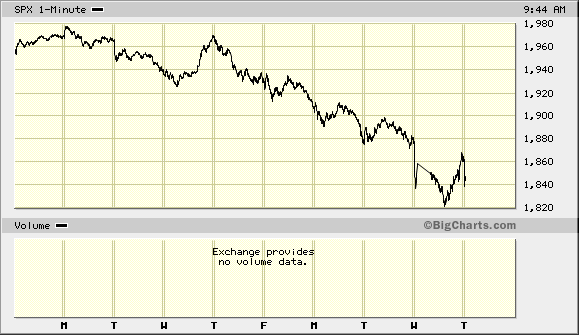
Posted by Eddy Elfenbein on October 16th, 2014 at 9:46 amThe stock market is down again today, but it feels as if the worst of the hysteria came yesterday. That’s a very unscientific point, but look at the minute-by-minute rise of the VIX over the past two weeks. It’s been very dramatic and we’re still below yesterday’s peak.
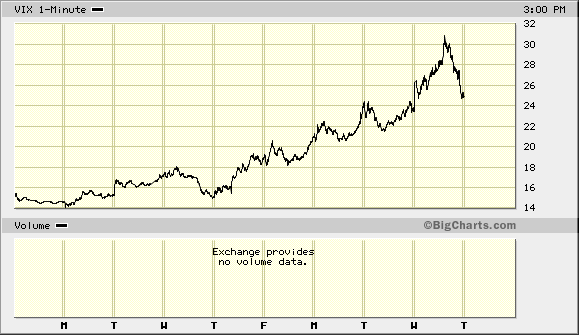
This may sound odd, but it’s not unusual for the market to meander lower after the peak in panic selling. Remember that the S&P 500 bottomed out in March 2009, a few months after the worst of the market’s turmoil.
Here’s a minute-by-minute look at the S&P 500:
-
Initial Claims Report Hit 14-Year Low
Posted by Eddy Elfenbein on October 16th, 2014 at 9:35 amInitial jobless claims dropped to 264,000 last week. That’s the lowest since April 15, 2000 when it was 259,000. This was the second lowest report since December 1, 1973.
-
Latest Budget Data
Posted by Eddy Elfenbein on October 16th, 2014 at 9:26 amThe government recently came out with the budget data for last year. Here’s what the chart looks like in log form. The budget deficit is still big, but it’s improved a lot.
-
Morning News: October 16, 2014
Posted by Eddy Elfenbein on October 16th, 2014 at 6:43 amStock Markets Are Waking Up to Economic Reality
Ebola Worries Fan Flight-to-Safety Trade
Falling Oil Prices Shake Up Global Economies
Greek Bond Yields Soar Towards 9%
Federal Reserve’s Beige Book Reports Moderate Economic Growth, Improving Job Conditions
Amazon to Hire 80,000 Workers for the Holidays
eBay Misses Earnings Estimates
Investors Slam Netflix Due to Slowing Subscriber Growth
Legal Charge for Mortgage Settlement Decreases Profit at Bank of America
Shire “Considering Situation” After AbbVie Balks At Merger
Buffett Cuts Tesco Stake After Saying Holding Was ‘Mistake’
Mattel Third-Quarter Profit Down 22% as Barbie Sales Fall
Nestle Chief Executive Sees Challenging Fourth Quarter
Edward Hugh: Eurocrisis Round Two, Blame the Germans Edition
Howard Lindzon: The Inconceivable Rally is Dead…Ebola and Netflix Killed It!
Be sure to follow me on Twitter.
-
Misusing Numbers
Posted by Eddy Elfenbein on October 15th, 2014 at 8:40 pmFrom CNBC:
Is Wall Street’s biggest question: After a 7 percent drop from the highs, has the S&P 500 bottomed out? The answer may be impossible to know for sure, but historical analysis suggests that stocks may have a bit further to fall.
Carter Worth of Sterne Agee looked back on all the market’s corrections of 5 percent or more going back to 1927, in order to get a sense of how long they tend to last, in terms of both time and magnitude. He learned that the average (mean) correction is 12.2 percent, and lasts for 41 sessions. The median correction, which is shallower because it is less affected by outliers, is 8.2 percentage points deep and lasts 22 sessions.
Given that the S&P closed Tuesday just over 7 percent off its highs, Worth takes this information as an indication that there will be more to this selloff.
“Were it to just be in line with the median, it means we have at least a percentage and a half to go. Were it to be in line with the mean or average decline, we’re talking about another 4 or 5 percent to go. The principle being that this is unlikely to be at an end,” Worth said Tuesday on “Futures Now.”
Let me see if I have this right: The average of all corrections of 5% or more is 12.2%. Since we’re down by more than 5% but not at the average yet, that suggests we have more to fall.
No. No it doesn’t.
The average of a group of corrections will always be more severe than the threshold. That says nothing about how the market has historically performed or what it’s inclined to do.
-
eBay Earns 68 Cents Per Share
Posted by Eddy Elfenbein on October 15th, 2014 at 5:37 pmAfter the bell, eBay ($EBAY) reported Q3 earnings of 68 cents per share. That was one penny more than expectations. Three months ago, the online auction house gave us a range of 65 to 67 cents per share. Quarterly revenue rose 12% to $4.4 billion which was slightly better than expectations.
“Rapidly changing competitive environments in commerce and payments underscore the opportunities for eBay and PayPal, and highlight how each business will benefit from the focus and agility of being an independent company,” said eBay Inc. President and CEO John Donahoe. “PayPal had another strong quarter, and its mobile payments leadership and momentum continued with mobile volume up 72 percent to $12 billion. PayPal is on track to process 1 billion mobile transactions in 2014. And eBay continues to focus on enhancing its competitive position, improving the experience for buyers and sellers and investing in consumer engagement. As we prepare to separate eBay and PayPal in 2015, our teams are focused on strong execution to ensure each business is set up for long-term success.”
Guidance was blah (to use a technical term). For Q4, eBay expects earnings to come in between 88 and 91 cents per share. Wall Street had been expecting 91 cents per share. The company expects Q4 revenue of $4.85 billion to $4.95 billion. Wall Street had $5.16 billion.
eBay lowered their full-year revenue guidance to $17.85 to $17.95 billion. The company doesn’t reference the old guidance but I’m pretty sure it was $18.0 to $18.3 billion. They also made no comment about full-year earnings guidance so I’m assuming the previous guidance of $2.95 to $3.00 per share still holds, but I can’t be sure.
By my math, eBay has earned $2.03 per share for the first nine months of this year. Tacking on the Q4 guidance to that, gives us a full-year range of $2.91 to $2.94 which doesn’t’ jive with what they’ve said. Maybe I’m missing something, or this will be cleared up on the conference call.
The shares dropped 3.6% in the after-hours market, but recovered a little ground and are now down about 1.5%.
-
Archives
- June 2026
- May 2026
- April 2026
- March 2026
- February 2026
- January 2026
- December 2025
- November 2025
- October 2025
- September 2025
- August 2025
- July 2025
- June 2025
- May 2025
- April 2025
- March 2025
- February 2025
- January 2025
- December 2024
- November 2024
- October 2024
- September 2024
- August 2024
- July 2024
- June 2024
- May 2024
- April 2024
- March 2024
- February 2024
- January 2024
- December 2023
- November 2023
- October 2023
- September 2023
- August 2023
- July 2023
- June 2023
- May 2023
- April 2023
- March 2023
- February 2023
- January 2023
- December 2022
- November 2022
- October 2022
- September 2022
- August 2022
- July 2022
- June 2022
- May 2022
- April 2022
- March 2022
- February 2022
- January 2022
- December 2021
- November 2021
- October 2021
- September 2021
- August 2021
- July 2021
- June 2021
- May 2021
- April 2021
- March 2021
- February 2021
- January 2021
- December 2020
- November 2020
- October 2020
- September 2020
- August 2020
- July 2020
- June 2020
- May 2020
- April 2020
- March 2020
- February 2020
- January 2020
- December 2019
- November 2019
- October 2019
- September 2019
- August 2019
- July 2019
- June 2019
- May 2019
- April 2019
- March 2019
- February 2019
- January 2019
- December 2018
- November 2018
- October 2018
- September 2018
- August 2018
- July 2018
- June 2018
- May 2018
- April 2018
- March 2018
- February 2018
- January 2018
- December 2017
- November 2017
- October 2017
- September 2017
- August 2017
- July 2017
- June 2017
- May 2017
- April 2017
- March 2017
- February 2017
- January 2017
- December 2016
- November 2016
- October 2016
- September 2016
- August 2016
- July 2016
- June 2016
- May 2016
- April 2016
- March 2016
- February 2016
- January 2016
- December 2015
- November 2015
- October 2015
- September 2015
- August 2015
- July 2015
- June 2015
- May 2015
- April 2015
- March 2015
- February 2015
- January 2015
- December 2014
- November 2014
- October 2014
- September 2014
- August 2014
- July 2014
- June 2014
- May 2014
- April 2014
- March 2014
- February 2014
- January 2014
- December 2013
- November 2013
- October 2013
- September 2013
- August 2013
- July 2013
- June 2013
- May 2013
- April 2013
- March 2013
- February 2013
- January 2013
- December 2012
- November 2012
- October 2012
- September 2012
- August 2012
- July 2012
- June 2012
- May 2012
- April 2012
- March 2012
- February 2012
- January 2012
- December 2011
- November 2011
- October 2011
- September 2011
- August 2011
- July 2011
- June 2011
- May 2011
- April 2011
- March 2011
- February 2011
- January 2011
- December 2010
- November 2010
- October 2010
- September 2010
- August 2010
- July 2010
- June 2010
- May 2010
- April 2010
- March 2010
- February 2010
- January 2010
- December 2009
- November 2009
- October 2009
- September 2009
- August 2009
- July 2009
- June 2009
- May 2009
- April 2009
- March 2009
- February 2009
- January 2009
- December 2008
- November 2008
- October 2008
- September 2008
- August 2008
- July 2008
- June 2008
- May 2008
- April 2008
- March 2008
- February 2008
- January 2008
- December 2007
- November 2007
- October 2007
- September 2007
- August 2007
- July 2007
- June 2007
- May 2007
- April 2007
- March 2007
- February 2007
- January 2007
- December 2006
- November 2006
- October 2006
- September 2006
- August 2006
- July 2006
- June 2006
- May 2006
- April 2006
- March 2006
- February 2006
- January 2006
- December 2005
- November 2005
- October 2005
- September 2005
- August 2005
- July 2005
 Eddy Elfenbein is a Washington, DC-based speaker, portfolio manager and editor of the blog Crossing Wall Street. His