-
Tough Times in Retail
Posted by Eddy Elfenbein on January 16th, 2014 at 11:49 amIt’s not just Bed Bath & Beyond. The entire retail sector has been hurting (Target, JC Penney, Best Buy, etc). The Retail ETF ($XRT) has trailed the market for eight of the last nine days. Check out the XRT’s relative strength.
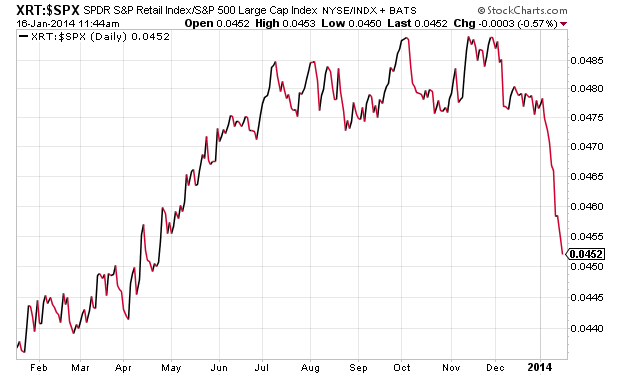
Many of the big retailers have quarters that end in January so it will be interesting to see how they report in February.
-
Morning News: January 16, 2014
Posted by Eddy Elfenbein on January 16th, 2014 at 6:26 amGlobal Economic Growth Is Expected To Speed Up This Year
Euro-Zone Inflation Rate Weakens in December
Job Slump Sends Aussie Lower as Rate-Cut Bets Revived
Senators Question Fed’s Review of U.S. Banks’ Commodities Units
Obama Names L.A.’s Maria Contreras-Sweet to Head SBA
Skeptics Question Banks’ Bottom Lines
Wall Street Sees Bitcoin’s Legacy as Payment System
Amazon Employees Reject Forming Company’s First Union in U.S.
TSMC Net Profit Beats Expectations
Yahoo’s No. 2 Is Out After Clash With CEO Mayer
AOL Gives Up Control of Money-Losing Local News Division Patch
Richemont Reports Sales-Growth Slowdown as China Performance Weakens
J.C. Penney to Cut 2,000 Jobs While Closing 33 Stores
Jeff Miller: Boost Your Dividend Yield
Roger Nusbaum: Gold Fight, Who Wins, Who Loses, What’s Really Important About Gold
Be sure to follow me on Twitter.
-
The Delayed Reaction to Wells
Posted by Eddy Elfenbein on January 15th, 2014 at 5:31 pmI wanted to make a brief comment on the recent price action of Wells Fargo ($WFC), and this is typical of how Wall Street behaves. The bank topped expectations by two cents per share yet the stock dropped yesterday morning after earnings.
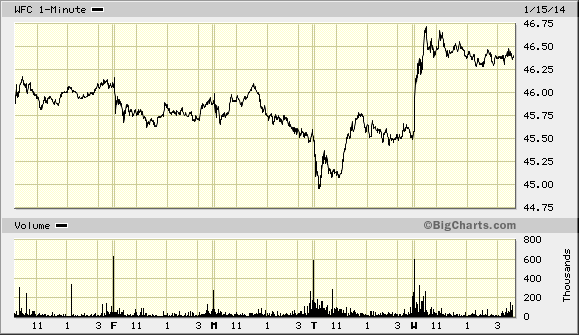
But after a day passed, the market suddenly changed its made and decided that the earnings were good. WFC rallied today and hit a fresh 52-week high.
Let me be clear: There was no important info that came out between the earnings report and today. Nothing. The market simply reacted first with fear, and then became more rational.
-
Investing Is a Bottom-Up Activity
Posted by Eddy Elfenbein on January 15th, 2014 at 7:56 amThe longer I’ve worked as an investor, the more I’ve come to realize that successful investing is a bottom-up process. By bottom-up, I mean it starts with the very basics of a company (its products and markets) and gradually works upwards from there (i.e., balance sheet, cash flow, valuation ratios).
The problem is that most people are strongly averse to this approach. I don’t know exactly why, but there’s a natural propensity to view the investing world top-down. This clouds nearly every investment discussion. Heck, I’m guilty of it myself.
Here’s how it works. An investment discussion (particularly in the media) invariably starts with the Federal Reserve and the macro economy. Then it works its way down to partisan politics: the budget, taxes and the debt. Throw in a discussion of EMH and how bad hedge funds are (curiously, we’re never told the flip side of EMH—that it’s impossible to lose to the market consistently before fees), and maybe touch on CAPE. Then if we’re lucky, one or two comments about Apple. And we’re done.
This is a huge disservice to readers, and almost none of it matters to being a good investor. The skill set one needs to be a shrewd stock picker doesn’t involve complex math or defending your political party. Rather, it’s closer to that possessed by an investigative reporter or a private eye. Don’t laugh. Whenever I’m in a department store, I’ve gotten in the habit of asking the kid behind the counter, “What’s popular?” He’ll tell you. In fact, he’ll tell you a lot. Just by doing this, you can learn a lot more than what a stock screener will tell you.
Look, I love financial ratios as much as anyone, but the information they give you is very limited. I’ve long called the Balance Sheet the overlooked cute sister of the 10-Q report, but even that only says so much. Here’s an important generality in corporate finance: a good company isn’t usually transformed into a bad one by taking on too much debt. Sure, it’s possible, and certainly it has happened before. But what really happens is that companies take on too much debt precisely because they’re bad. They have a growing need to mask their deficiencies.
A few years ago, I stumbled across Nicholas Financial (NICK). I’ve probably written about this stock more than any other. NICK isn’t followed by any analyst. It rarely generates news. I visited a branch office and later called up the CFO. He patiently answered my many questions. With a little bit of work, I probably knew more about them than anyone outside HQ.
I remember when NICK dropped below $1.64 per share five years ago. It’s really hard to believe in efficient markets when your stock is trading at one-fifth book value and roughly one times earnings for the year after next. The market was offering me dollars for dimes, and I bought them. (NICK just agreed to be bought out at $16 per share.) Inflation, Obamacare, the euro—none of that mattered. To be fair, the Fed’s low rates played a role in helping NICK, but connecting that policy to being a NICK bull would be a stretch.
I also have a growing distrust and outright aversion to the tiresome bull-bear debate (Barry Ritholtz has led the charge on this for years). It’s a fun parlor game, but again, how does it help investors? Not much.
Another favorite game of the top-down view is to find a sector that ought to be big in the future. I know! Green Energy! Robotics! Biotech! China! Chinese robots producing green energy biotech!!
A basic fact about business is that money can be made just about anywhere. Your objective shouldn’t be finding the next so-and-so. You should try to find superior ROE. No top-down approach would lead anyone to Danaher (DHR), but it’s been one of the best-performing stocks of the last few decades. Their stable of businesses is pretty ordinary. That’s what they do, and they do it well.
My advice to investors is to grant yourself a healthy distance from those who view investing from 30,000 feet. It’s easy to wave your hand and say everything’s overpriced and the Dow could go to 1,000. Instead, if you’re interested in a company, start at the ground level and found out why it’s successful.
-
Morning News: January 15, 2014
Posted by Eddy Elfenbein on January 15th, 2014 at 6:30 amWorld Bank Is Expecting Widespread (if Still Possibly Turbulent) Growth for 2014
EU Lawmakers Seal Deal on Financial Market Rules Overhaul
German Economy Grows at Modest Pace
China Bank Lending Slows as PBOC Walks Policy Tightrope
Why Trying to Hurt China in the Trade Game Could Backfire
Japan Approves Tepco Turnaround Plan
Tullow Finds More Kenyan Oil Boosting East Africa Export Plans
Senate Hearing Set to Press for Quicker Commodity Bank Curbs
What Stanley Fischer Did at the IMF
China’s Huawei Profit Jumps on Smartphones, U.S. Asks Hua-Who?
Charter Woos Time Warner Cable Holders
Bernard Madoff Haunts JPMorgan’s Earnings
General Motors to Resume Paying Dividend After 6 Years
Edward Harrison: Privacy and the Ubiquity of Embedded Technology
Epicurean Dealmaker: A Fine Disregard for the Rules
Be sure to follow me on Twitter.
-
Babcock & Wilcox
Posted by Eddy Elfenbein on January 14th, 2014 at 11:33 amOne of these days, I should start a Boring Portfolio of good stocks that are as dull as dirt. Sometimes I really wonder if people understand that the stock market is more than Google, Apple, Facebook and Twitter.
The truth is there are lots of great companies out there, and many of them barely make a peep. Some of them like Moog ($MOG-A) make it on to the Buy List. Harris ($HRS), a former member, is another good example. If you’ve read me for a while, you may recognize other boring standouts like ACE Limited ($ACE) or Raven Industries ($RAVN). International Flavors & Fragrances ($IFF) is another good example.
Here’s another boring stock to put on your radar, Babcock & Wilcox ($BWC). BWC has a noble history going back nearly 150 years. They developed boilers that were used on early steamships and Teddy Roosevelt’s Great White Fleet. They also helped develop the first nuclear-powered subs.
BWC was eventually forced into bankruptcy as a result of asbestos litigation. The company eventually merged from bankruptcy and was spun-off by McDermott International. BWC started trading on the NYSE three years ago.
Here’s the company’s profile via Yahoo Finance:
The Babcock & Wilcox Company operates as a specialty constructor of nuclear components for various customers in the power and other steam-using industries worldwide. Its Power Generation segment designs, engineers, manufactures, supplies, constructs, and services utility and industrial power generation systems, including boilers used to generate steam in electric power plants, pulp and paper making, chemical and process applications, and other industrial uses. This segment also offers technologies to control nitrogen oxides, sulfur dioxide, fine particulate mercury, acid gasses, and hazardous air emissions; and construction services to steam generation or environmental equipment projects, and cogeneration and combined cycle installations, as well as provides environmental equipment and components, and related services. The companys Nuclear Operations segment manufactures naval nuclear reactors for the U.S. Department of Energy/National Nuclear Security Administration’s Naval Nuclear Propulsion Program, which in turn supplies them to the U.S. Navy for use in submarines and aircraft carriers. Its Technical Services segment offers services to the U.S. Government comprising uranium processing, environmental site restoration services, and management and operating services for various U.S. Government-owned facilities. The companys Nuclear Energy segment fabricates pressure vessels, reactors, steam generators, heat exchangers, and other auxiliary equipment. This segment also offers engineering services, such as structural component design, 3-D thermal-hydraulic engineering analysis, weld and robotic process development, and metallurgy and materials engineering. In addition, it provides power plant construction, management, and maintenance services; and services for nuclear steam generators and balance of plant equipment, as well as nondestructive examination and tooling/repair solutions. The company was founded in 1867 and is headquartered in Charlotte, North Carolina.
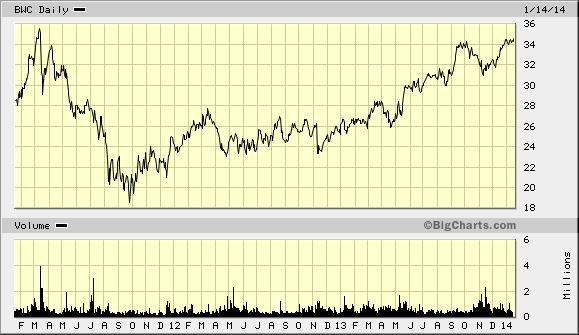
The company also has zero long-term debt and trades at 14 times next year’s earnings.
-
Wells Fargo Earns $1 Per Share
Posted by Eddy Elfenbein on January 14th, 2014 at 9:45 amFourth-quarter earnings are out for Wells Fargo ($WFC). The big bank earned $1 per share which beat estimates by two cents per share. For Q4 of 2012, Wells earned 91 cents per share. For the quarter, net income was up 10% and for the year, it was up 16% to $21.9 billion.
Chief Executive Officer John Stumpf, 60, is trimming staff and expenses as rising interest rates curtail demand for home refinancings. Wells Fargo had vowed to reduce overhead after expenses surged above its target in the previous three months.
(…)
Revenue slid 6 percent in the quarter to $20.7 billion from a year earlier and 3 percent for the full year to $83.8 billion, while profit before taxes and provisions fell 5 percent. Non-interest expense dropped 6 percent and the efficiency ratio, which measures costs as a percentage of revenue, improved to 58.5 percent from 59.1 percent in the third quarter and 58.8 percent a year earlier.
Segment Results
Profit rose in all three operating segments, with the greatest percentage gains coming in wealth, brokerage and retirement, the unit run by David Carroll. Mortgage originations fell to $50 billion, a 38 percent decline from the third quarter, and mortgage-banking income fell by almost half from year-earlier levels to $1.57 billion.
Net interest margin, the difference between what the bank makes on lending and pays for funds, fell to 3.26 percent from 3.38 percent in the third quarter.
The annual profit represents the fifth straight record year for the lender, which doubled its size with the 2008 purchase of Wachovia Corp. It was the first year since 2009 that profit surpassed New York-based JPMorgan Chase & Co., the biggest U.S. lender by assets, which earned $17.9 billion for all of 2013 — a 16 percent drop.
Wells Fargo, which ranks fourth by assets, gained 33 percent in New York trading last year, trailing the 35 percent return for the 24-company KBW Bank Index. The stock closed at $45.56 yesterday and declined to $45.43 at 8:19 a.m. in New York.
(…)
Wells Fargo, responsible for about 1 in 5 U.S. mortgages last year, has profited from Federal Reserve policies that lowered mortgage rates and sparked a refinancing wave. As rates have risen, applications have slowed and cut into originations. Rates on 30-year mortgages averaged 4.51 percent last week, up from 3.35 percent in early May, according to Freddie Mac.
Stumpf announced 5,300 job cuts in the third quarter, and another 925 in October. The impact began to take effect in the fourth quarter, according to a Nov. 7 presentation and may reduce costs by as much as $750 million annually, Deutsche Bank AG analysts wrote in a Jan. 3 report.
The bank is also facing fewer costs tied to litigation and legal expenses than its peers. Through the first nine months of 2013, those expenses fell 1.2 percent to $413 million, according to regulatory filings.
Legal settlements and other costs related to mortgage lending and sales should continue to decline, Stumpf said during a Dec. 10 investor conference. The bank began an internal ethics review this month that could last as long as two years, with plans to examine standards for how employees should act and procedures for handling conflicts of interest across more than 80 business lines.
-
Morning News: January 14, 2014
Posted by Eddy Elfenbein on January 14th, 2014 at 6:39 amEurozone Industrial Output Surges in November
Japanese Stocks Suffer Worst Day in Five Months After U.S. Jobs Report
India Considers Lifting Ban on Airbus Superjumbos
ECB’s Nowotny Would Like Better Financing for SMEs
U.S. Lawmakers Leave IMF Resources Request Out of Spending Bill
Consumers Vent Frustration and Anger at Target Data Breach
Time Warner Cable Rejects $61 Billion Bid From Charter
Suntory Overseas Thirst Drives Higher Beam Deal Value
Volvo Cars Recorded Profits in 2013, Unlike 2012
AstraZeneca Sees 2017 Revenue in Line With 2013 Level
McKesson May Pursue Celesio Joint Venture After Failed Bid
Ranbaxy Falls on USFDA Concerns; Brokers Downgrade
Lamborghini Plans SUV in 2017 in Luxury Push Into Segment
Jeff Carter: Be Like Bill Murray
Joshua Brown: Technical and Fundamental Arguments Against the Secular Bull Thesis
Be sure to follow me on Twitter.
-
Ford is the Talk of the Auto Show
Posted by Eddy Elfenbein on January 13th, 2014 at 9:43 pmI discussed this before, but Ford‘s ($F) new F-150 is making waves at the Detroit Auto Show. The new line’s trucks are made out of alumuninum. They’re more expensive, but they are more fuel efficient.
From the AP:
Ford Motor Co. unveiled the 2015 F-150, whose body is 97-percent aluminum, on Monday. The lighter material shaves as much as 700 pounds off the 5,000-pound truck, a revolutionary change for a vehicle known for its heft and an industry still reliant on steel. No other vehicle on the market contains this much aluminum.
“It’s a landmark moment for the full-size pickup truck,” said Jack Nerad, editorial director for Kelley Blue Book.
The change is Ford’s response to small-business owners’ desire for a more fuel-efficient and nimble truck — and stricter government requirements on fuel economy. It sprang from a challenge by Ford’s CEO to move beyond the traditional design for a full-size pickup.
(…)
Ford is taking a big risk. F-Series trucks — which include the F-150 and heavier duty models like the F-250 — have been the best-selling vehicles in the U.S. for the last 32 years; last year, Ford sold an F-Series every 41 seconds. Ford makes an estimated $10,000 profit on every F-Series truck it sells. Michael Robinet, the managing director of IHS’s automotive group, says the trucks account for about a third of the company’s revenue in North America — $80 billion in 2012.
“Anytime you make a change with that vehicle, it’s got to be well thought out, because you are really playing with the crown jewels of that company,” Robinet said.
(…)
The 2015 F-150 goes on sale late this year. As for cost, Ford wouldn’t reveal prices, but its truck marketing chief Doug Scott says the F-Series will stay within its current price range even though aluminum costs more than steel. F-Series trucks now range from a starting price of $24,445 for a base model to $50,405 for a top-of-the-line Limited.
Pete Reyes, the F-150’s chief engineer, said Ford expects to make up the premium by reducing its recycling costs, since there will be less metal to recycle, and by slimming down the engine and other components, since they won’t have to move so much weight.
Aluminum is widely used on sporty, low-volume cars now, like the Tesla Model S electric sedan and the Land Rover Evoque. U.S. Postal Service trucks are also made of aluminum.
(…)
Improvements in aluminum are also driving the change. Three years ago, for example, Alcoa Inc. — one of Ford’s suppliers for the F-150 — figured out a way to pretreat aluminum so it would be more durable when parts are bonded together. Carmakers can now use three or four rivets to piece together parts that would have needed 10 rivets before, Alcoa spokesman Kevin Lowery said.
And Ford is able to take more risks. When the F-150 was last redesigned, in the mid-2000s, Ford was losing billions each year and resources were spread thin. But by 2010, when the company gave the green light to an all-aluminum truck, Ford was making money again. Mulally, a former Boeing Co. executive who joined Ford in 2006, encouraged his team to think bigger. After all, it was Mulally who led early development of Boeing’s Dreamliner, which replaced aluminum with even lighter-weight plastics to be more efficient and fly further.
(…)
Ford is convinced truck buyers will accept the change. The company says the new truck will tow more and haul more. The frame — which does most of that work — is still made of high-strength steel, and the engine doesn’t have to account for so much weight. It can also accelerate and stop more quickly. Aluminum doesn’t rust, Ford says, and it’s more resistant to dents.
Reyes says the company planted prototype F-150s with three companies — in mining, construction and power — for two years without revealing they were aluminum. The companies didn’t notice a difference.
-
The S&P 500 Drops -1.26%
Posted by Eddy Elfenbein on January 13th, 2014 at 4:35 pmUgly day today. At noon, the market was mostly unchanged, but then Dennis Lockhart, the president of the Atlanta Fed, said he supports more tapering (he’s not a voting member this year). The market started to head south. By the closing bell, the S&P 500 had dropped down to 1,819.20 which is its lowest close since December 20th. For the day, the index lost -1.26%.
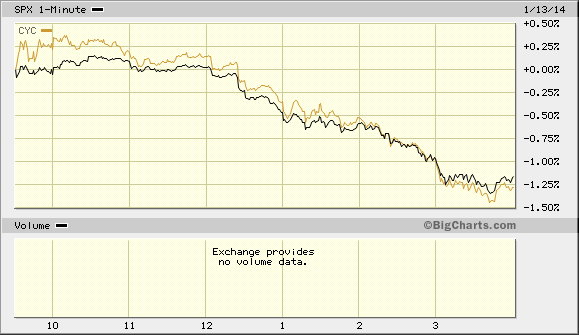
My take: I don’t think there’s any real news here. The Fed will most likely continue with tapering this year but hold off on any rate increases.
Breaking down the market, the biggest damage today came among cyclical stocks. The energy, consumer discretionary, and financials got hit the most while utes, healthcare and staples were down least. Bonds were up, but not by much. The 10-year yield fell to 2.83% which is 21 points below its peak from December 31.
Our Buy List had a rough day. We lost 1.27% on the day which was almost the same as the S&P 500. Eighteen of our 20 stocks lost ground; only Ford ($F) and eBay (EBAY) made money. Ford made a lot of headlines with the unveiling of its new F-150 at the Detroit Auto Show. The new pickups are made out of aluminum. Although they cost more, they’re more fuel efficient.
Our worst performers today were Microsoft ($MSFT), Bed Bath & Beyond ($BBBY) and Cognizant ($CTSH). Next up, we get the earnings report from Wells Fargo ($WFC).
-
Archives
- June 2026
- May 2026
- April 2026
- March 2026
- February 2026
- January 2026
- December 2025
- November 2025
- October 2025
- September 2025
- August 2025
- July 2025
- June 2025
- May 2025
- April 2025
- March 2025
- February 2025
- January 2025
- December 2024
- November 2024
- October 2024
- September 2024
- August 2024
- July 2024
- June 2024
- May 2024
- April 2024
- March 2024
- February 2024
- January 2024
- December 2023
- November 2023
- October 2023
- September 2023
- August 2023
- July 2023
- June 2023
- May 2023
- April 2023
- March 2023
- February 2023
- January 2023
- December 2022
- November 2022
- October 2022
- September 2022
- August 2022
- July 2022
- June 2022
- May 2022
- April 2022
- March 2022
- February 2022
- January 2022
- December 2021
- November 2021
- October 2021
- September 2021
- August 2021
- July 2021
- June 2021
- May 2021
- April 2021
- March 2021
- February 2021
- January 2021
- December 2020
- November 2020
- October 2020
- September 2020
- August 2020
- July 2020
- June 2020
- May 2020
- April 2020
- March 2020
- February 2020
- January 2020
- December 2019
- November 2019
- October 2019
- September 2019
- August 2019
- July 2019
- June 2019
- May 2019
- April 2019
- March 2019
- February 2019
- January 2019
- December 2018
- November 2018
- October 2018
- September 2018
- August 2018
- July 2018
- June 2018
- May 2018
- April 2018
- March 2018
- February 2018
- January 2018
- December 2017
- November 2017
- October 2017
- September 2017
- August 2017
- July 2017
- June 2017
- May 2017
- April 2017
- March 2017
- February 2017
- January 2017
- December 2016
- November 2016
- October 2016
- September 2016
- August 2016
- July 2016
- June 2016
- May 2016
- April 2016
- March 2016
- February 2016
- January 2016
- December 2015
- November 2015
- October 2015
- September 2015
- August 2015
- July 2015
- June 2015
- May 2015
- April 2015
- March 2015
- February 2015
- January 2015
- December 2014
- November 2014
- October 2014
- September 2014
- August 2014
- July 2014
- June 2014
- May 2014
- April 2014
- March 2014
- February 2014
- January 2014
- December 2013
- November 2013
- October 2013
- September 2013
- August 2013
- July 2013
- June 2013
- May 2013
- April 2013
- March 2013
- February 2013
- January 2013
- December 2012
- November 2012
- October 2012
- September 2012
- August 2012
- July 2012
- June 2012
- May 2012
- April 2012
- March 2012
- February 2012
- January 2012
- December 2011
- November 2011
- October 2011
- September 2011
- August 2011
- July 2011
- June 2011
- May 2011
- April 2011
- March 2011
- February 2011
- January 2011
- December 2010
- November 2010
- October 2010
- September 2010
- August 2010
- July 2010
- June 2010
- May 2010
- April 2010
- March 2010
- February 2010
- January 2010
- December 2009
- November 2009
- October 2009
- September 2009
- August 2009
- July 2009
- June 2009
- May 2009
- April 2009
- March 2009
- February 2009
- January 2009
- December 2008
- November 2008
- October 2008
- September 2008
- August 2008
- July 2008
- June 2008
- May 2008
- April 2008
- March 2008
- February 2008
- January 2008
- December 2007
- November 2007
- October 2007
- September 2007
- August 2007
- July 2007
- June 2007
- May 2007
- April 2007
- March 2007
- February 2007
- January 2007
- December 2006
- November 2006
- October 2006
- September 2006
- August 2006
- July 2006
- June 2006
- May 2006
- April 2006
- March 2006
- February 2006
- January 2006
- December 2005
- November 2005
- October 2005
- September 2005
- August 2005
- July 2005
 Eddy Elfenbein is a Washington, DC-based speaker, portfolio manager and editor of the blog Crossing Wall Street. His